
Non-Obvious Toolbox Talk Topics: 6 Nobody Runs On A Construction Crew
The obvious toolbox talk topics are reminders, not induction. Then 6 numbered topics nobody runs: goals for the day, fatigue, harassment, silence, leave, near misses.
A toolbox talk is not an induction. Induction carries the big-picture safety content. The talk carries today's reminders, in five minutes. The 6 topics nobody runs:
- Goals for the day — the target nobody says out loud
- Fatigue and the drive home — the part of the shift you never brief
- Harassment — a psychosocial hazard under the WHS Act, not an HR folder
- A talk where nobody speaks — not consultation under section 48
- A worker back from a week off — unacclimatised, same as a new starter
- The near miss where nothing happened — still legally notifiable
Run the obvious reminders fast. Spend your five minutes on these.
Every crew on every site has heard the dust talk. They have heard the exclusion zone talk. They have heard the one about lifting with your legs.
That is the problem with most toolbox talk topics. They are correct, they are compliant, and they change nothing, because the crew stopped listening on the second word.
A talk the crew can predict is a talk the crew is not hearing.So here is the obvious list, framed properly and run quickly. Then six numbered topics almost nobody delivers, each one traceable to SafeWork NSW, Safe Work Australia or the Fair Work Commission. 🚧
Table of Contents
- What are the obvious toolbox talk topics?
- 1. Goals for the day
- 2. Fatigue and the drive home
- 3. Harassment on your site
- 4. The talk where nobody speaks
- 5. The bloke back from leave
- 6. The near miss you have to report
- Bonus: the five-minute delivery
- Frequently Asked Questions
What are the obvious toolbox talk topics?
Start with the frame, because almost every bad toolbox talk gets this wrong.
A toolbox talk is not an induction. The induction carries the safety. The talk carries the reminders.Big-picture safety belongs in the induction: the site rules, the emergency plan, the SWMS, the high-risk work, the hazards that live on this project for the next nine months. That is a sit-down, it is documented, and it happens once.
The toolbox talk is the opposite. Today's hazards, today's zones, today's goals. Five minutes, standing up, this crew, this shift.
So the obvious list is a reminder list, not a syllabus:
- Today's site-specific hazards, not construction in general
- Today's exclusion zones and who moves the barricade
- PPE for today's task, not PPE as a concept (the NSW baseline)
- Plant and pedestrian separation, including reversing and spotters
- Dust and silica, especially cutting, grinding and dry sweeping
- Working at heights, edge protection, and dropped objects below
- Heat and hydration on the back half of a hot week
- Electrical and underground services, permits, and tag-outs
- Housekeeping, because most trips are cables and offcuts
- Where to report a hazard, and who to tell before smoko
That is your bank. Ten reminders, rotated, and none of them are insight.
Reminders keep you compliant. They do not change what the crew does at 2pm.
The six below do, because the crew has genuinely not heard them. Numbered, so you can count what you are actually running.
1. Goals for the day
Ask a crew at 7am what "done" looks like by 3pm and watch how many different answers you get.
The toolbox talk is the only moment in the day when the whole crew is standing in one place before the work starts. Most supervisors spend it entirely on hazards and never say the target out loud.
That is a wasted five minutes, and it is why crews drift.
A crew that does not know the target sets its own pace. Usually the slowest one on site.Naming the goal is also a safety control, not just a productivity one. Unreasonable time pressure and poor task clarity are named psychosocial hazards by SafeWork NSW, and both of them start with a crew that was never told what the day required.
How to run this one
- Say what finished looks like at 3pm, in site language: "slab prepped to the northern hoist"
- Name who owns which zone, so nobody waits for permission at 11am
- Say the one thing that would derail it, and who to tell if it starts
- Ask whether the target is realistic before the shift, not at 2:45pm
The crew you can push is the crew you told the plan to. Everyone else is just guessing.
2. Fatigue and the drive home
Every fatigue talk ever run covers the shift. Almost none cover the forty minutes after it.
The Safe Work Australia model Code of Practice on managing the risk of fatigue at work, updated September 2025, treats fatigue as a work health and safety risk with consequences that scale.
The code puts the range plainly. A fatigued worker might shut a hand in a door, or might drive off the road.
Then the part that stops a crew mid-yawn.
A fatigued worker who crashes on the way home can be a notifiable incident, if the fatigue arose out of the work.That is not a wellbeing message. That is your shift design showing up in a police report.
How to run this one
- Ask who is on their sixth or seventh straight day, and count the hands
- Ask how far they drive, and who is doing more than an hour each way
- Name the two worst windows: the early hours and the mid-afternoon dip
- Tell them the code expects workers to take reasonable care not to drive fatigued
- Then do the thing that makes it real: change one roster line this week
A fatigue talk that ends with no roster change is theatre. The crew knows it.
3. Harassment on your site
This is the topic supervisors skip because it feels like an office problem. It is not, and the law does not treat it as one.
Harassment, bullying and aggression are psychosocial hazards under the SafeWork NSW Code of Practice on managing psychosocial hazards at work, issued in May 2021 under section 274 of the WHS Act. The Work Health and Safety Regulation 2025 strengthened it further by requiring the hierarchy of control measures to be applied.
SafeWork NSW also publishes a construction-specific action plan for psychosocial risks, which tells you how seriously the regulator takes this sector.
Harassment sits under the same Act as your edge protection. It is a hazard, not a HR folder.The Fair Work Commission defines workplace bullying as repeated unreasonable behaviour towards a worker that creates a risk to health and safety. It also draws the line the crew will ask about: reasonable management action carried out in a reasonable way is not bullying.
So you can direct the work. You cannot spray a bloke and call it standards.
How to run it without the word "psychosocial"
Say "psychosocial" to a crew at 6:45am and you lose them in one syllable. Talk about the behaviours instead.
- The sprays that get excused as banter, especially aimed at the youngest bloke on the tools
- Comments about someone's accent, religion or where they are from
- Anything sexual said to or about a worker, which is its own jurisdiction at the Fair Work Commission
- Freezing someone out of the crew, which is bullying without a single raised voice
- Job insecurity used as a threat, which lands hardest on casual and rotating workers
Then say the two things the crew actually needs to hear. This is not tolerated here, and here is exactly who you tell.
Sit in the silence afterwards. Someone will use it. We go deeper on the site-level version of this in psychosocial safety on Sydney sites.
4. The talk where nobody speaks
The toolbox talk is not a briefing. Legally it is consultation, and consultation has a definition.
There is no law that says "run a toolbox talk". There is a duty to consult under the Work Health and Safety Act 2011, and SafeWork NSW names toolbox talks as one of the accepted ways to meet it.
Here is the part that catches people. Section 48 requires that workers get a reasonable opportunity to express their views and contribute to the decision.
A talk delivered at a silent crew does not do that. The signed sheet proves attendance.
Your attendance sheet proves they were standing there. It does not prove you consulted them.And the sheet itself is not the compliance artefact people assume. SafeWork NSW is clear that there is no general requirement to document consultation unless the WHS Regulation specifically calls for it. Record keeping is good practice, because it helps demonstrate you met the duty.
So record the useful thing. What was asked, and what you did about it.
The bit that matters on a mixed site
Most Sydney sites run several payrolls at once. Yours, two subbies, a labour hire crew, a couple of traffic controllers.
SafeWork NSW states that labour hire workers, apprentices and trainees have the same consultation rights as everyone else, and that businesses sharing a duty of care must consult with each other and with each other's workers.
Translation: if they are on your site, they are in your talk. Payroll is irrelevant.
⚠️ The common gap: the labour hire crew arrives at 6:50am, the talk ran at 6:40am, and nobody re-runs it. That is a documented consultation failure and a real hazard gap, and it happens on Sydney sites every week. See host employer responsibilities for where that duty sits.
5. The bloke back from leave
Everyone knows the new starter is at risk in the heat. Here is what almost nobody briefs.
SafeWork NSW states that workers who are not acclimatised, or who are returning after being away for a week or more, are at higher risk of heat-related illness.
Read that again. A week off resets him.
The chippy back from annual leave, the labourer who had the flu, the bloke who did a fortnight of indoor fit-out and is now on a slab in February. All of them are, for heat purposes, brand-new workers.
Seven days away and his body forgets. He does not, which is exactly the problem.
Worse, he is the confident one. He has done this job for nine years, so he will not pace himself and he will not say anything.
The controls SafeWork NSW actually names
- Ease them in gradually rather than straight onto the hardest task
- Allocate extra breaks in the first days back
- Slowly increase the workload across the week
- Do not rely on acclimatisation as a control measure, because it varies by person
- Run any formal acclimatisation program with a professional such as an occupational hygienist
The practical version for a leading hand takes ten seconds. 🎯 Ask who has been off for a week or more, then do not put those names on the worst task before smoko.
6. The near miss you have to report
Most crews think reporting is about injuries. Most supervisors quietly think the same.
SafeWork NSW defines a notifiable incident as a death, a serious injury or illness, or a dangerous incident. A dangerous incident, commonly called a near miss, is reportable when it exposed a person to a serious risk to health or safety.
Some must be notified even when nobody was injured.
The classic site examples: a load swinging out of control, an object falling uncontrolled from height, plant collapsing or overturning, contact with live electrical, an uncontrolled escape of gas, dust or a substance.
Nobody hurt. Still notifiable. Immediately, on 13 10 50.
The maximum penalty for failing to notify is $50,000 for a body corporate and $10,000 for an individual, per SafeWork NSW. That is for the failure to make a phone call about an incident where nobody was hurt.
Why the crew stays quiet
Because on most sites a report reads as blame. On a rotating crew it reads as something worse: the bloke who caused a stir does not get booked next week.
You have to say the opposite out loud, in the talk, in front of everyone.
Nobody has ever lost a shift here for reporting something. That is the deal.
Then hold to it, because the crew will test it once and never test it again.
The near miss you never hear about is the incident you will hear about next month.
Bonus: the five-minute delivery
The six topics are the post. This last bit is the bonus, because a good topic delivered badly still dies.
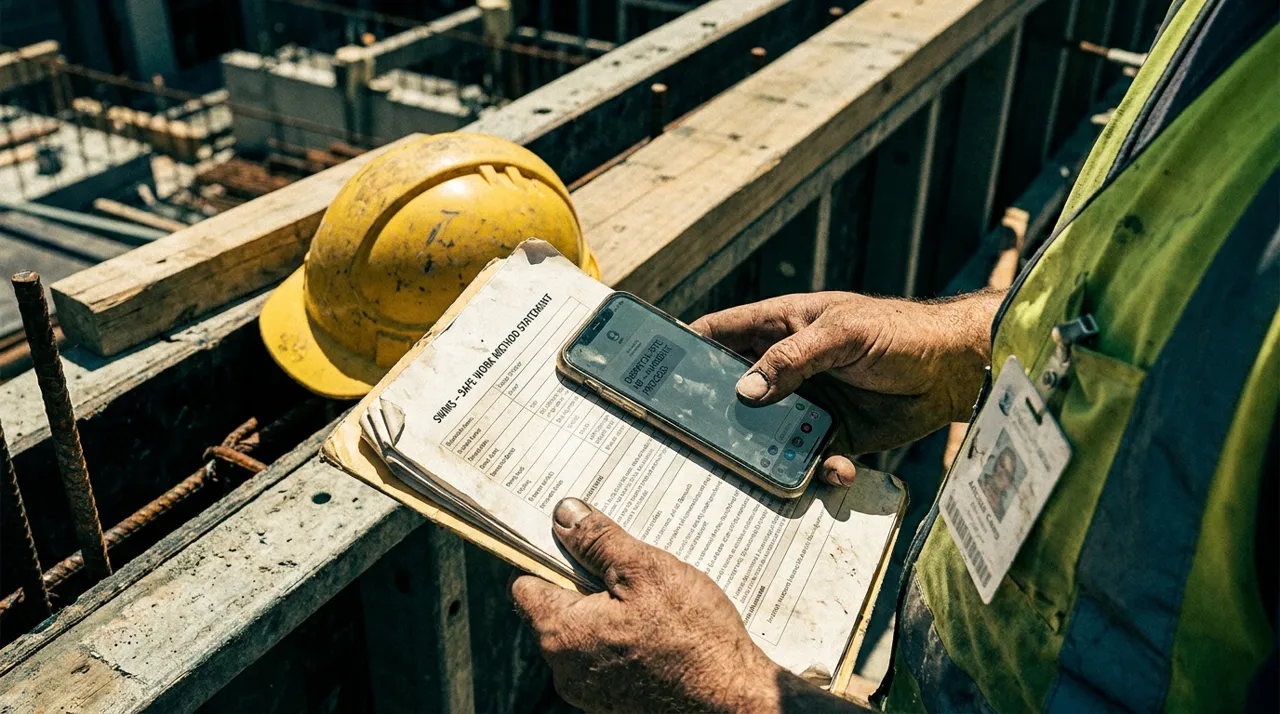
Four moves, in order.
Three rules underneath those moves. Do not read the sheet, because reading signals paperwork and the crew mirrors it. One topic only, since a talk with six topics has zero. Name the action, not the principle: not "be aware of plant", but "nobody walks behind the excavator, use the west path".
The one habit worth stealing. Ask the question, then say nothing until somebody answers. Most supervisors fill the silence in three seconds and never learn a thing. The crews with the best safety records are run by people who are comfortable being quiet in front of twenty blokes.
And if half your crew rotates weekly, the induction has to carry its weight too, because the talk cannot cover what the induction skipped. That is the whole argument for treating induction and daily briefing as one system rather than two forms.
Get Started
Running a crew where half the faces change every fortnight makes all of this harder, and skipping it makes it worse.
If you want workers who turn up already inducted, already ticketed and already used to being asked a question at 6:45am, see how we allocate and brief crews or read the full guide to leading a labour hire crew in Sydney.
Frequently Asked Questions
What are the best toolbox talk topics for a construction crew?+
The obvious bank is reminders: today's site-specific hazards, today's exclusion zones, PPE for today's task, plant and pedestrian separation, dust and silica, heights, heat, services, housekeeping and reporting. Run those fast. The six topics that actually change behaviour are the ones nobody runs: goals for the day, fatigue on the drive home, harassment and the other psychosocial hazards, the talk where nobody speaks, the worker back from a week off, and the near miss that is legally notifiable.
Is a toolbox talk the same as a site induction?+
No. The induction is where the big-picture safety content belongs: the site rules, the emergency plan, the SWMS, the high-risk work, the whole-of-project hazards. The toolbox talk is a reminder. It covers today's hazards, today's zones and today's goals for this crew, in about five minutes. Using the toolbox talk to deliver induction material is why crews stop listening, and it does not fix a missing induction.
Is a toolbox talk legally required in NSW?+
No specific toolbox talk is mandated, but the consultation duty under the Work Health and Safety Act 2011 is. SafeWork NSW names toolbox talks as one accepted way to meet it. Section 48 requires that workers get a reasonable opportunity to express views and contribute, so a talk delivered at a silent crew does not meet the intent even if everyone signs the sheet.
Is harassment a toolbox talk topic or an HR matter?+
Both, and the WHS side comes first. Harassment, bullying and aggression are psychosocial hazards under the SafeWork NSW Code of Practice on managing psychosocial hazards at work, issued in May 2021 under section 274 of the WHS Act, so they carry the same duty as a physical hazard. The Fair Work Commission separately defines workplace bullying as repeated unreasonable behaviour that creates a risk to health and safety, and reasonable management action carried out reasonably is not bullying. Naming the behaviours in the talk is the control, not the HR policy sitting in a folder.
Should a toolbox talk cover the goals for the day?+
Yes, and it is the most under-used topic on any site. The toolbox talk is the only moment the whole crew is standing together before work starts, so it is where the day's target gets said out loud: what finished looks like, who owns which zone, and what would derail it. A crew that knows the target paces itself and flags the blocker early. A crew that only gets a hazard list works to whatever pace it guesses.
Do I have to record my toolbox talks?+
There is no general requirement under WHS laws to document consultation unless the WHS Regulation specifically requires it. SafeWork NSW still treats record keeping as good practice because it helps demonstrate compliance. The record proves attendance, not consultation, so note the questions asked and the actions taken, not just names.
How long should a toolbox talk be?+
Five minutes covering one topic beats fifteen minutes covering six. Crews retain the single thing you asked them to repeat back. Anything longer and the talk competes with the start of the shift, and the crew starts watching the crane instead of you.
Do labour hire and subcontract workers get the same consultation rights?+
Yes. SafeWork NSW is explicit that labour hire workers, apprentices and trainees have the same consultation rights as everyone else, and businesses that share a duty of care must consult with each other and with each other's workers. If a worker is on your site under someone else's payroll, they are in your toolbox talk.
Which near misses do I have to report to SafeWork NSW?+
A dangerous incident is notifiable even when nobody is injured, if it exposed a person to a serious risk to their health or safety. That includes uncontrolled falls of objects, plant collapse, electrical contact, and uncontrolled escapes of substances. Notification is immediate on 13 10 50, and the maximum penalty for failing to notify is $50,000 for a body corporate and $10,000 for an individual.