

The Real Reason You Can't Keep Good Workers: Psychosocial Safety on Sydney Sites (2026)
Bad site leadership is why good workers vanish and never come back. Psychosocial safety is now NSW WHS law — and the biggest retention lever you're ignoring. Real stats, plain-English duty, and the moves that actually keep a crew.
If you keep losing good workers, the problem usually isn't pay — it's how your site treats people. NSW WHS law now calls that psychosocial safety, and it's your biggest hidden retention lever.
- The blunt version: unbearable leadership makes good workers leave and never come back
- The law: every PCBU must manage psychosocial hazards so far as is reasonably practicable — enforced by SafeWork NSW
- The cost: ~30% of construction turnover is linked to mental health; poor mental health costs Aussie business ~$11B/yr
- The crisis: ~190 construction workers die by suicide each year — roughly twice the rate of other employed men
- The fix: put psychosocial safety in the induction, kill the bullying, and check in on your crew — a post-shift call goes a long way
- The partner: a labour hire provider that vets and supports workers carries half the duty for you
Table of Contents
- The Hidden Reason Good Workers Stop Showing Up
- The Numbers Nobody Puts on the Site Noticeboard
- "Construction Is Hard" Is Not a Licence to Be Insufferable
- Psychosocial Safety Is Now NSW Law — in Plain English
- What Actually Drives Your Crew Off (the Hazards)
- Who Owes the Duty for a Labour Hire Worker?
- Make Psychological Safety Part of the Induction
- Go Beyond: The Moves That Keep a Crew
- Why This Saves You Money, Not Costs It
- How the Right Labour Hire Partner Carries Half the Load
- Do This on Your Site This Month
- Frequently Asked Questions
The Hidden Reason Good Workers Stop Showing Up
You booked a solid hand. Showed up early, knew the job, easy to have on site. Three weeks later they're gone — took the next booking somewhere else and won't pick up when your allocator calls.
You blamed the rate. Or the commute. Or "no one wants to work anymore."
It usually wasn't any of that.
It was the site. The supervisor who tears strips off people in front of the crew. The program that's always a body short, so everyone's flogged. The bloke who raised a real safety concern and got told to harden up. Good workers don't make a scene. They just don't come back.
Here's the part most builders miss: the thing driving them off has a legal name now. It's called a psychosocial hazard — and in NSW, managing it is your duty, not a nice-to-have.
The reason you can't staff your jobs might be standing in your own hi-vis, holding the clipboard.
This isn't about going soft. It's about the most practical problem you've got — a crew you can actually keep — and the cheapest lever you're not pulling.
The Numbers Nobody Puts on the Site Noticeboard
Before the eye-rolls about "mental health stuff" — look at what the data says about your own industry.
A worker in construction is far more likely to die by suicide than from a fall, a crush, or any site accident — the thing your whole SWMS is built around. The crisis isn't on the scaffold. It's in the head of the bloke standing on it.
And the young ones cop it worst:
- 29% of construction apprentices reported suicidal thoughts in the past year (MATES Apprentice report)
- 31% of those apprentices reported being bullied in the previous six months (same report)
- Around 30% of turnover in the sector is linked to mental health (Roads Australia mental-health study)
- Poor mental health costs Australian businesses roughly $11 billion a year in absenteeism, lost productivity and re-hiring (Foremind industry summary)
Illustrative split — the point isn't the exact ratio, it's that the danger most builders never plan for is the one most likely to take a worker out.
Read those again with your own crew in mind. The quiet apprentice. The forklift driver who's gone flat. The bloke who used to crack jokes and now just keeps his head down. The statistics aren't strangers. They're people you've had on site.
Construction workers die by suicide at roughly twice the rate of other employed men. This is a safety issue with a body count — not HR fluff.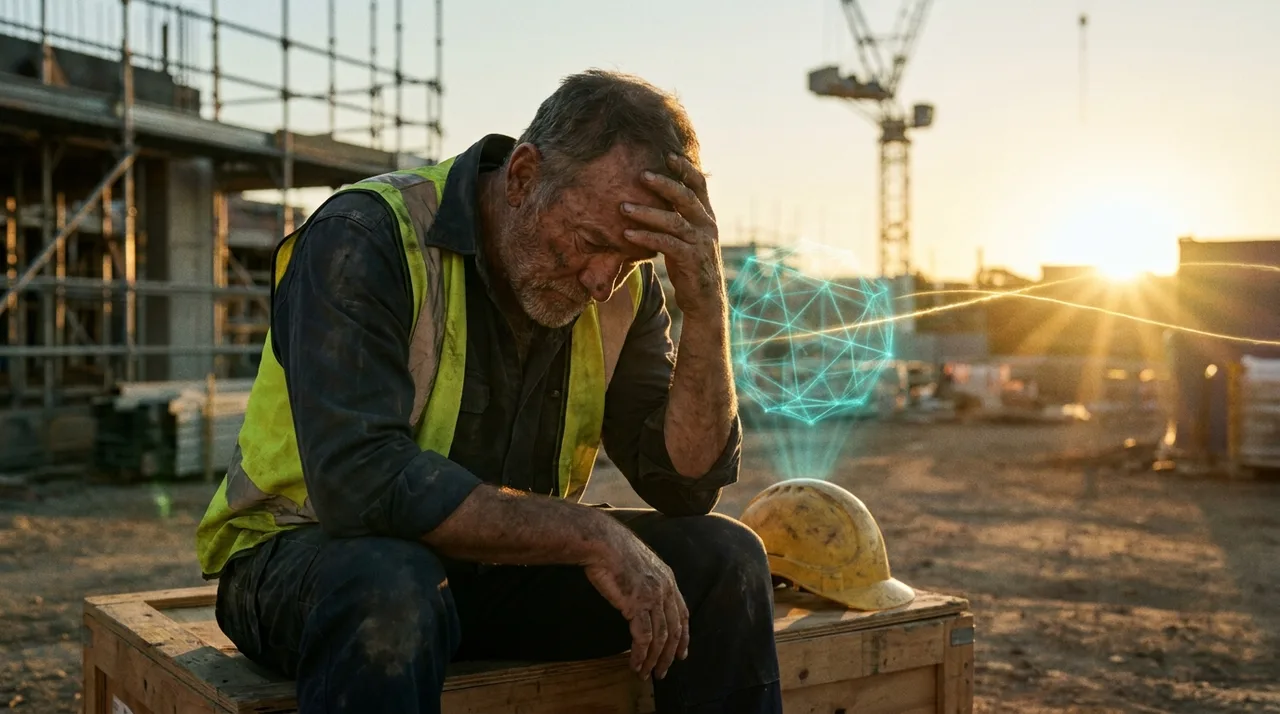
"Construction Is Hard" Is Not a Licence to Be Insufferable
Yes, the work is hard. Early starts, weather, pressure, real risk. Nobody's pretending a building site is a wellness retreat.
But "the work is hard" gets used as cover for something different: leadership that's hard to be around. The two aren't the same.
- Hard work is a 6am pour in the rain. Workers respect that.
- Insufferable leadership is being humiliated for asking a question, blamed for a program that was never realistic, or having a genuine concern waved off.
Workers will break their backs for a leader who's demanding but decent. They will walk — every time — from one who's demanding and demeaning. The job being tough is exactly why the person running it shouldn't add to the load for sport.
⚠️ The tradie who "doesn't take any crap" and "tells it how it is" is often just the reason your retention is rooted. Crews don't quit hard work. They quit being treated like dirt.
The old-school "toughen up" culture isn't toughness. It's the thing the data above is measuring. And in NSW, it's now the thing the regulator measures too.
Psychosocial Safety Is Now NSW Law — in Plain English
This stopped being optional in 2021. SafeWork NSW published the Code of Practice "Managing psychosocial hazards at work" (May 2021 — the first of its kind in Australia), and the duty sits squarely under the WHS Act.
A PCBU is a Person Conducting a Business or Undertaking. If you run a Sydney site, that's you. Your primary duty is to ensure, so far as is reasonably practicable, the health and safety of workers — and "health" now expressly includes psychological health.
"So far as is reasonably practicable" doesn't mean eliminate every stressor. It means run the same loop you already run for physical risk:
For years "safety" meant hard hats, edge protection and a clean SWMS. That floor hasn't moved. The psychosocial duty sits on top of it — and it's the layer most Sydney builders haven't wired in yet.
The Code of Practice treats a toxic site the same way it treats an unguarded edge: a hazard you must identify, assess, control and review.What Actually Drives Your Crew Off (the Hazards)
A psychosocial hazard is anything in how work is designed, organised or managed that can harm a worker's mental or physical health. On a Sydney site they're concrete, not abstract.
The SafeWork NSW Code specifically calls out poor workplace relationships and bullying and high job demands with inadequate support as hazards a PCBU must record and act on — not personality clashes to ignore.
None of these get fixed by a poster in the lunch shed. Each is the 6am no-show, the worker who quietly walks at smoko, the crew that turns over every six weeks. Each one has a control.
📋 The test isn't whether a worker "should've toughened up." It's whether the way the work was set up created a foreseeable risk to their health — and whether you did something reasonably practicable about it.
Who Owes the Duty for a Labour Hire Worker?
Both you and the agency. This is the part most builders get wrong.
When you book a labour hire worker, two PCBUs owe that worker a duty at the same time — and it isn't split 50/50. Each owes the full duty, and the law requires the two to consult, cooperate and coordinate.
| Criteria | Host Builder | Labour Hire Provider |
|---|---|---|
| Site demands, pace, program, layout | Primary | Consulted |
| Worker vetting, induction, support | Consulted | Primary |
| Bullying / harassment on site | Primary | Backs up |
| Fatigue (shift design, breaks) | Primary | Monitors |
| Off-site support for the worker | Limited | Primary |
| The legal duty itself | Full | Full |
Highlighted cells = best option per criterion
In practice: you control the site culture the worker walks into. The agency controls who that worker is, how they were inducted, and whether anyone has their back off-site. A worker raises a concern to the agency allocator? That has to reach you — and vice versa. Where it breaks down, both PCBUs are exposed.
You can share the psychosocial duty with your provider. You can't outsource it. But a good provider carries its half so the gap doesn't land on you.Make Psychological Safety Part of the Induction
Here's the move almost nobody makes: put psychosocial safety in the site induction, right alongside the fall risk and the exclusion zones.
You already induct every worker on the physical hazards. The duty says psychological hazards are hazards too — so treat them the same. It costs you five minutes and it sets the tone before the first shift.
When a worker hears on day one that this site takes the head as seriously as the hands, two things happen: the ones doing it tough know there's a door to knock on, and the ones inclined to bully know the standard. Safety includes the psychological — say so out loud, in the induction.
Safety inductions cover the edge, the gear and the exclusion zone. Add the bit that's actually most likely to harm a worker: name the no-bullying standard, the escalation path, and where to get help. Five minutes on day one beats re-inducting a replacement in week four.
Go Beyond: The Moves That Keep a Crew
Meeting the legal duty is the floor. Keeping good workers is about going past it — and the moves that work are small, human and cheap.
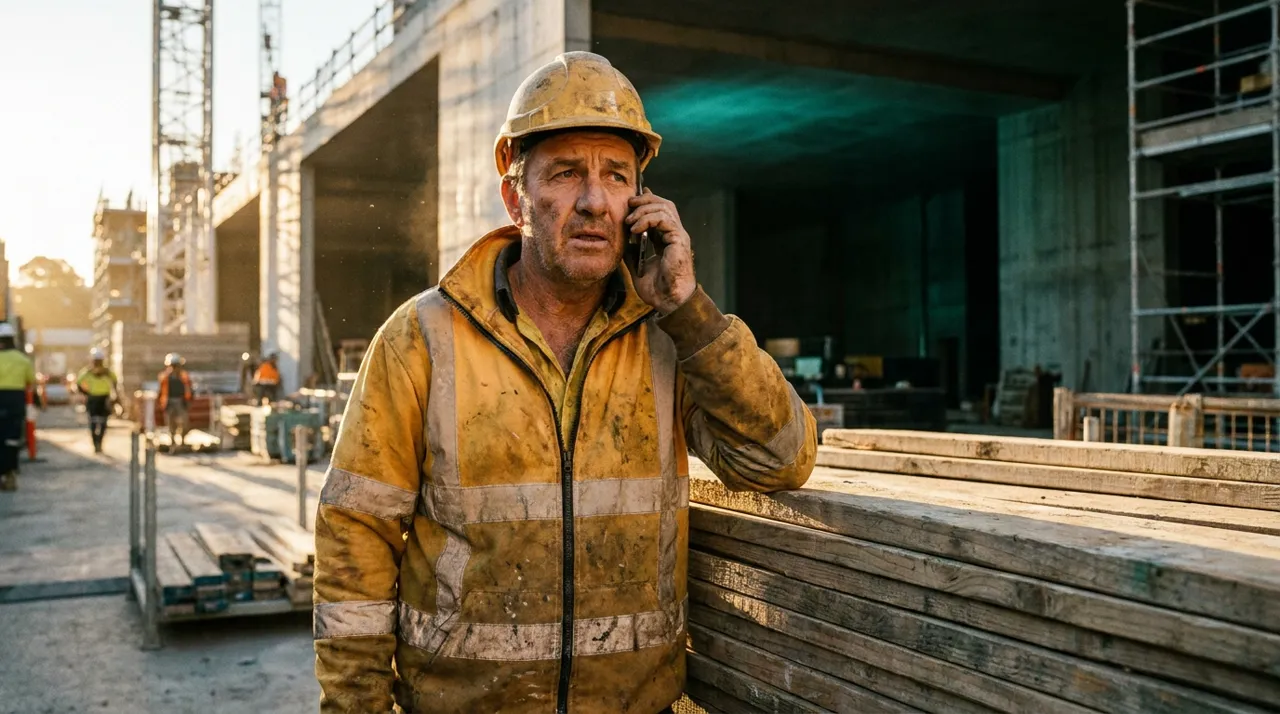
Give your crew a call after a brutal shift. Not about the job — about them. "You alright, mate? That was a rough one today." Ninety seconds. It tells a worker they're a person to you, not a body on a timesheet. That single habit does more for retention than any bonus.
This is the heart of R U OK? — the Australian movement built on one idea: a genuine "are you OK?" can change, or save, a life. R U OK? Day lands on the second Thursday of September, but the point isn't one day a year. It's the question, asked for real, whenever someone seems off.
The practical "go beyond" list:
- Notice the change. The bloke who's gone quiet, short-fused, or always "tired" — that's a signal, not an annoyance.
- Ask twice. "Yeah, fine" on the first ask often isn't. A second, genuine "no, really — you good?" opens the door.
- Know the numbers. Lifeline 13 11 14 (24/7), MATES in Construction 1300 642 111, Beyond Blue 1300 22 4636. Put them on the noticeboard and in the induction.
- Protect the quiet ones. Bullying thrives where leadership looks away. Don't.
- Build sane rosters. A worker finishing at 8pm and starting at 5am is a fatigue risk to themselves and the crew. Fix the roster.
⚠️ If you or someone on your crew is struggling: Lifeline 13 11 14 is free, confidential and open 24/7. MATES in Construction runs a 24/7 line on 1300 642 111 built specifically for the industry. You don't have to wait for a crisis to use them.
Why This Saves You Money, Not Costs It
Set the human side aside for a second — the cold maths still points the same way.
A site that grinds workers down leaks money through the exact drains that wreck your schedule:
Remember the data: roughly 30% of sector turnover is tied to mental health, and poor mental health costs Australian business about $11 billion a year. Every worker who walks is a re-induction, a re-brief, and a learning curve you pay for twice.
And there's a reputation cost that doesn't show on any invoice. Word travels through the labour pool fast. A site known as a meat-grinder gets the bottom of the barrel — and pays a premium to get even that. A site known as fair gets first pick, and gets it back when it asks.
Psychosocial safety isn't a cost centre. It's the same lever that kills no-shows, turnover and absenteeism — the three things that blow your program and your budget.How the Right Labour Hire Partner Carries Half the Load
Because the duty is shared, the provider you pick changes how much risk and churn lands on you.
A hands-off provider — one that just throws a body at the site — leaves its half of the duty unmet. That gap doesn't vanish; it lands on you as the host PCBU, and it shows up as the worker who never comes back.
A provider that does the work carries its half:
- Vets workers properly — the right person for the task, not a warm body
- Inducts and supports them — so they arrive ready, not thrown in cold
- Has someone they can reach off-site — the support leg the host can't cover
- Consults and coordinates — feeds your site concerns back, flags worker issues early
- Matches qualification to task — workers only go on jobs they're cleared for
That's how Leap is built. Workers are vetted, inducted and supported, and the host site is treated as a partner in the shared duty — not a hand-off. When a worker raises something with our allocator, that's information that protects your site too.
We run On-Hire or Subcontract mode depending on the job: under On-Hire you direct the day-to-day work and we payroll and support the worker; under Subcontract we deliver a defined outcome under our own supervision. Either way the worker is Leap's employee — vetted and backed by us. We supply standard PPE (hard hat, hi-vis, steel-capped boots, gloves) and carry Public Liability plus statutory workers compensation cover. The site-specific psychosocial controls — your program, your supervisor, your culture — sit with you as host; we coordinate with you on them rather than pretend they're not shared.
For the wider host-employer picture, see our host employer responsibilities guide and our overview of labour hire compliance in Sydney. For how our model trims your compliance load, see how Leap's AI agents handle the middle office and our construction labour hire service.
Do This on Your Site This Month
Four moves, none of them heavy:
- Add psychosocial hazards to your risk assessment. You already assess physical risk — extend the same process to demands, support, fatigue and bullying. The SafeWork NSW Code of Practice is the template.
- Put it in the induction. Name the no-bullying standard, the escalation path, and the support numbers — Lifeline 13 11 14 and MATES in Construction 1300 642 111 — on day one, for every worker including labour hire crew.
- Make the check-in a habit. A post-shift "you alright, mate?" after a hard day. Notice the change. Ask twice. That's R U OK? in practice, not just in September.
- Coordinate with your provider. Confirm in writing that they vet, induct and support their workers, and agree how site concerns flow both ways. That's the shared duty working as designed.
⚠️ This article explains the duty in plain terms — it isn't legal advice. For binding detail, work from the SafeWork NSW Code of Practice and your own WHS adviser. The duty is real and enforceable in NSW; your specific obligations depend on your site.
If you'd rather book crew from a provider that already carries its half of the duty — vetted, inducted, supported workers, with the coordination built in — tell us what your site needs.
Frequently Asked Questions
Why can't I keep good labour hire workers on my site?+
Usually it isn't the rate — it's how the site treats people. Relentless pace, getting bawled out in front of the crew, no one checking in, no clear way to raise a problem. Good workers don't argue; they take the next booking somewhere they're treated decently and they don't come back. NSW WHS law calls these psychosocial hazards, and managing them is the single biggest lever you have on retention.
Does NSW WHS law require builders to manage psychosocial hazards?+
Yes. Under NSW WHS law every PCBU has a primary duty to manage psychosocial hazards so far as is reasonably practicable — the same legal footing as physical hazards. SafeWork NSW enforces it and published the Code of Practice "Managing psychosocial hazards at work" in May 2021 as the practical standard an inspector will hold you to.
What are psychosocial hazards on a construction site?+
High job demands, low job control, poor support, bullying and harassment, fatigue, exposure to traumatic events, and role overload or conflict. Each is something in the design, organisation or management of work that can cause psychological or physical harm. The SafeWork NSW Code specifically lists poor workplace relationships, bullying and high job demands among them.
How bad is mental health in Australian construction?+
Around 190 construction workers die by suicide in Australia each year — roughly one every second day — and male construction workers die at about twice the rate of other employed men (MATES in Construction). A worker is far more likely to die by suicide than from a site accident. Among apprentices, 29% reported suicidal thoughts in the past year and 31% reported being bullied in the previous six months. It's a safety problem with a body count, not a soft issue.
Should psychosocial safety be part of site induction?+
Yes. Treat psychological safety like any other hazard: name it in the induction, explain the no-bullying standard, show the escalation path, and tell every worker — including labour hire crew — who to talk to if they're struggling. Put the support numbers (Lifeline 13 11 14, MATES in Construction 1300 642 111) where everyone can see them. If it isn't in the induction, you haven't really managed it.
Who owes the psychosocial duty for a labour hire worker — the builder or the agency?+
Both. The host builder and the labour hire provider are each a PCBU and each owes the worker the full duty at the same time. Under NSW WHS law it's a shared, concurrent duty, and the two must consult, cooperate and coordinate. You can share the duty but you cannot contract out of it — and a hands-off provider leaves its half on your side as the host.
What does R U OK? have to do with construction sites?+
R U OK? is an Australian movement built on one idea: a genuine "are you OK?" can change, or save, a life. Given how many construction workers struggle silently with stress, addiction and suicidal thoughts, a real check-in — including a quick call after a brutal shift — is one of the cheapest, most effective controls a site leader has. R U OK? Day is the second Thursday of September, but the question matters every day.
Does managing psychosocial safety actually save money?+
Yes. Around 30% of construction turnover is linked to mental health, and poor mental health costs Australian businesses roughly $11 billion a year through absenteeism, lost productivity and re-hiring. A supported worker who isn't run into the ground shows up, stays, and keeps your program moving. Churn — re-inducting and re-briefing a fresh body every few weeks — is the expensive option.
The reason you can't keep good workers might not be the pay. It might be the site. Fix that, and the crew sticks.
Leap Labour is a Sydney-based labour hire agency supplying general hands, forklift drivers, skilled labourers, traffic controllers and leading hands across construction and warehouse sectors. Leap workers are vetted, inducted and supported, with Public Liability and statutory workers compensation cover. This article explains the NSW WHS psychosocial duty in plain terms and is not legal advice — work from the SafeWork NSW Code of Practice and your own adviser for binding detail. If you or someone you know is struggling, contact Lifeline on 13 11 14, MATES in Construction on 1300 642 111, or Beyond Blue on 1300 22 4636. Learn more about the R U OK? movement. All placements comply with Fair Work and SafeWork NSW requirements.