

From Desk to Site: Starting in Construction When AI Takes Your Office Job
Practical guide for white collar workers displaced by AI. What construction site work actually looks like, how to start with casual labour hire, and which skills transfer.
White collar workers displaced by AI can enter construction through casual labour hire with minimal barriers. A White Card (~$100, 1 day) and PPE are the only requirements. Casual general labourers in Sydney earn $34–$38/hr. Office skills like plan reading, scheduling, and computer literacy transfer directly and are valued on site.
You open your laptop on a Tuesday morning and there it is. The subject line you have been half-expecting for six months.
"Organisational restructure — your role has been impacted."
You are an estimator. Or a scheduling coordinator. Or the accounts payable person who has been processing invoices for a tier-one builder for the last four years. And the software that took three months to "pilot" just made your role redundant.
Not because you were bad at your job. Because an algorithm got good enough at it.
This article is for you.
Not a motivational speech. Not a "learn to code" lecture. A practical, honest guide to what construction site work actually looks like, what it takes to start, and why casual labour hire might be the smartest move you make this year.
Table of Contents
- The Shift Happening in Construction Right Now
- What a Day on Site Actually Looks Like
- Getting Started — The Minimum You Need
- First Jobs You Can Realistically Take
- The Casual Advantage — Try Before You Commit
- Pay Reality — What You Will Actually Earn
- Skills That Transfer (More Than You Think)
- Do Your Research First
- The Mindset Shift Nobody Prepares You For
- Frequently Asked Questions
1. The Shift Happening in Construction Right Now
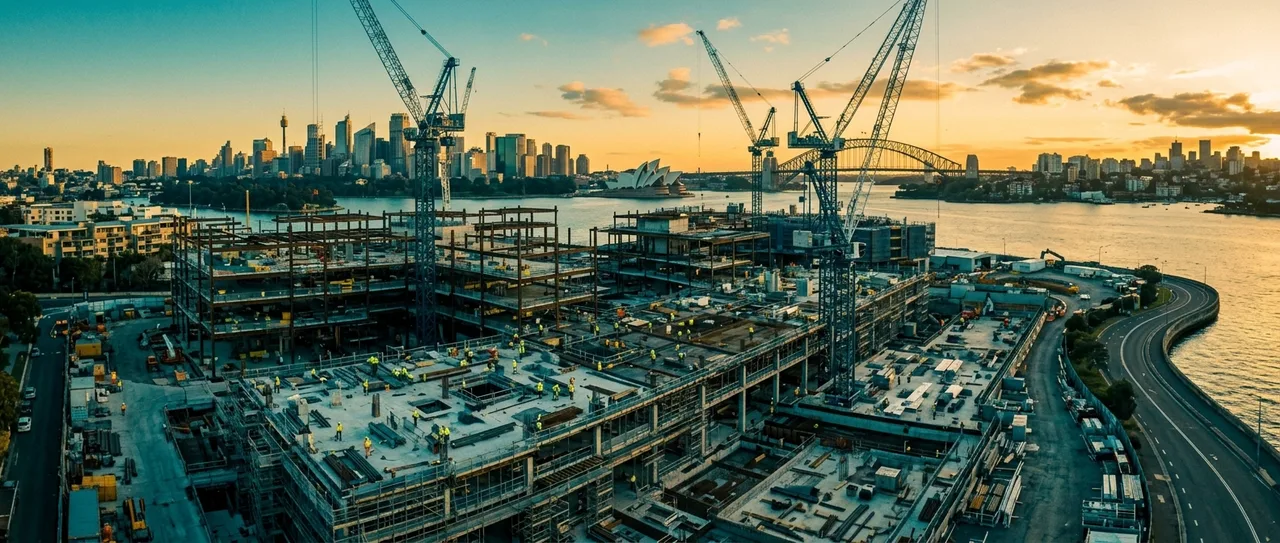
AI is changing white-collar roles in construction. Estimating, scheduling, document management, accounts payable — teams that had four people now have one person and a software subscription. If your office role was made redundant, you are not imagining the trend.
But here is what matters: physical construction work is not going anywhere. Robots are not laying bricks. Machines are not replacing labourers, dogmen, or riggers. The technology to automate physical site work is years — probably decades — away from being practical or affordable. 🏗️ Blue-collar construction jobs are safe for the foreseeable future.
And the demand has never been higher. Sydney is in the middle of a housing crisis, an infrastructure boom, and a skilled labour shortage that gets worse every quarter. Builders cannot find enough workers. Projects are delayed because there are not enough hands on site — across construction, demolition, and civil works alike. 💰 The pay is solid and the barriers to entry are lower than almost any other industry.
The industry that is shrinking your desk job has never been more desperate for people willing to do the physical work. That is the opportunity.
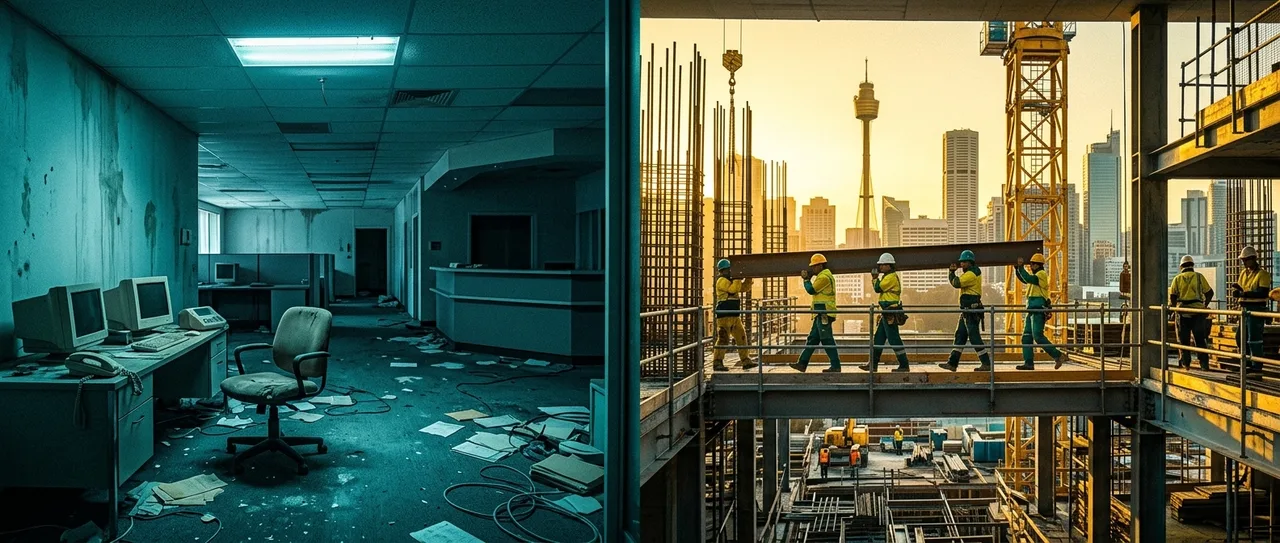
2. What a Day on Site Actually Looks Like
You need to know this before you do anything else. Not the brochure version. The real version.
5:45am — Your alarm goes off.
Not a typo. Most construction sites in Sydney start at 7:00am. You need to be dressed, fed, and on site before the toolbox talk. If you are commuting from Western Sydney to the CBD, you are leaving the house before sunrise.
This is the single biggest culture shock for office workers. You cannot ease into the morning with a coffee and emails. You are standing in boots and hi-vis by 7am, and the day has started whether you are ready or not. ⚠️ There is no "logging on slowly."
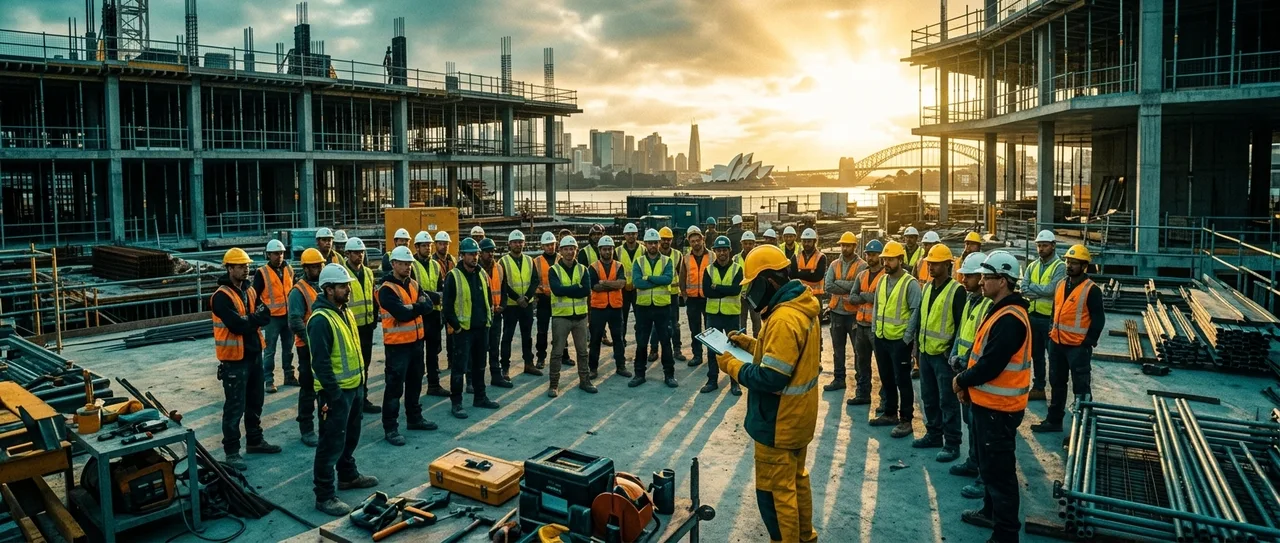
7:00am — Toolbox talk and safety briefing.
Every site, every morning. The foreman or site supervisor runs through the day's plan, any hazards, any changes. You sign the attendance sheet. This is a legal requirement, not a suggestion. Pay attention — the information is specific to what is happening on site that day, and it can save your life.
7:15am — Work starts.
Whatever the task is, it starts now. If you are a general labourer, that might be unloading a delivery truck, carrying plasterboard up two flights of stairs, shovelling gravel into a trench, or sweeping a slab before the concreters arrive. The work is physical. You are on your feet. You are lifting, carrying, pushing, pulling.
10:00am — Smoko (morning break).
Fifteen to twenty minutes. You eat. You drink water. You sit down. This is not optional — your body needs it. 💡 Experienced workers bring food. New workers bring nothing and wonder why they are destroyed by lunchtime.
12:30pm — Lunch.
Thirty minutes. On large sites there is a lunch shed. On smaller sites, you eat in your car or on a stack of timber. Lunch is at a set time — not "whenever you get to it." If the supervisor calls lunch at 12:30, you stop at 12:30.
1:00pm — Back to work.
The afternoon is harder than the morning. Your body is tired. The sun is up. If it is summer in Sydney, you are working in 30-35 degree heat wearing long sleeves, boots, a hard hat, and safety glasses. Hydration is not a wellness tip — it is a survival requirement.
3:00–3:30pm — Pack up and clean.
Here is the part nobody tells you: construction finishes early. While your old office mates are still in their 3pm meeting, you are cleaning your work area, stacking tools, and heading to the car. On a standard 8-hour day starting at 7:00am, you knock off at 3:30pm. That is real. That is every day.
You start earlier than any office job you have ever had. But you finish earlier too. No 6pm emails. No "just one more thing." When the site shuts, you are done. Your evening is yours — and it starts at 3:30pm.
The PPE reality.
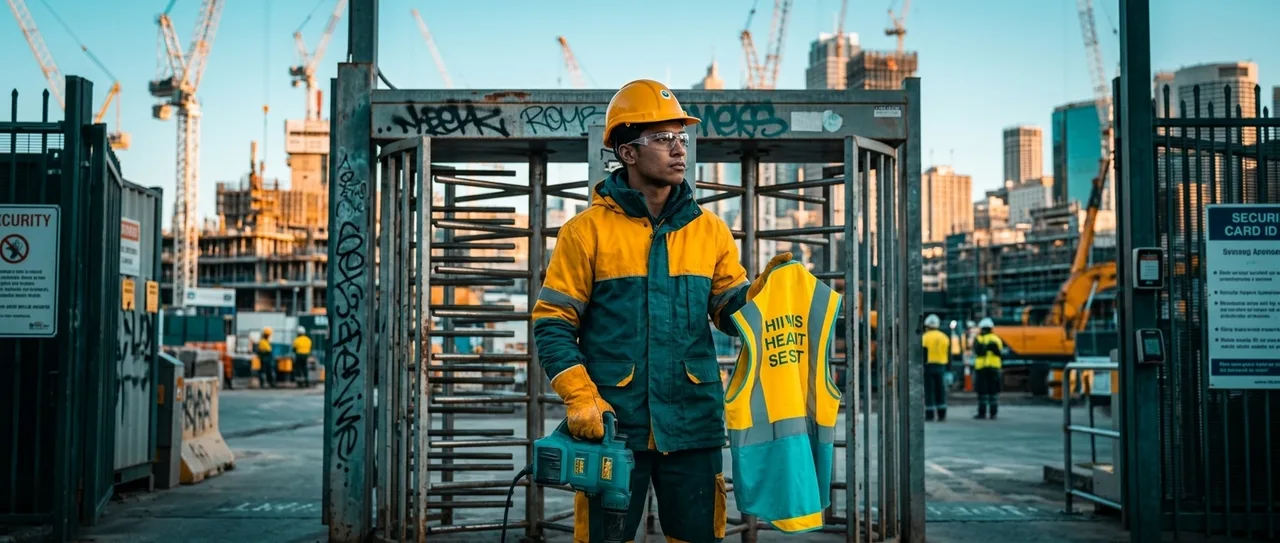
You will wear steel-cap boots all day. A hi-vis shirt or vest. A hard hat. Safety glasses. On some sites, gloves and ear protection. In winter, you are cold at 7am and comfortable by 10am. In summer, you are hot by 8am and miserable by 1pm. There is no air conditioning. There is no thermostat.
You get used to it. Everyone does. But the first week is a shock.
The team dynamic.
Construction crews are tight. The banter is relentless. If you are new, you will be tested — not maliciously, but to see if you can take a joke and give one back. If you have thin skin, thicken it. If you work hard and do not complain, you will be accepted faster than you expect.
Nobody cares about your degree. Nobody cares about your old job title. They care about whether you show up on time, do what you are told, and do not create problems.

3. Getting Started — The Minimum You Need
This is the part where most career-change articles get vague. "Research your options." "Consider your transferable skills." "Speak to a career counsellor."
No.
Here is exactly what you need to walk onto a construction site in Sydney.
That is it. Five steps. 📋 Total investment: $210–$370 and a few weeks of preparation.
Compare that to retraining for a new office career: a $15,000 diploma, 12 months of study, and no guarantee of a job at the end.
If you have been sedentary for a long time, do some basic physical preparation before your first shift. A few weeks of daily walking and bodyweight exercises will make the first week much easier. If you are already active — gym, sports, running — you will be fine. The work is demanding but your body adapts fast when it is already used to moving.
4. First Jobs You Can Realistically Take
Here is where we need to be honest with you.
You are not walking into a site manager role. You are not getting hired as a project coordinator on day one, even if that is what you did in an office. The site version of those roles goes to people with years of on-site experience. Your office experience will help you get there faster — but you need to start.
General Labourer — The Starting Point
This is where most people begin. Carrying materials, cleaning up after trades, unloading deliveries, assisting where needed. It is physical, it is unglamorous, and it is available right now.
General labouring is not the destination. It is the door. 🏗️ You walk through it, learn how a site works, prove you can handle the environment, and then you move. The difference between you and someone who started at 18 is that you will move faster — because you already understand systems, timelines, and communication.
For a detailed breakdown of what general labourers do vs skilled labourers, see our guide on skilled vs general labourers.
Traffic Controller — Best Entry Point for Pay vs Physical Demand
One-day course. Approximately $300. And you are qualified for a role paying 💰 $35–$42/hr with significantly less physical demand than general labouring.
Traffic controllers manage vehicle and pedestrian movement around construction sites. You stand, you direct, you stay alert. It is not physically brutal, but it requires focus and the ability to stay sharp for 8 hours.
For office workers, this is often the best first step. The training is fast, the pay is strong, and the work is manageable while your body adapts to outdoor conditions.
Warehouse Coordination and Pick/Pack
If you have logistics experience, a warehouse background, or you understand inventory systems — warehouse work is a natural fit. The physical demands are real but more predictable than construction. The environment is sheltered. The hours are more varied.
With a forklift licence, your earning potential jumps to $38–$45/hr. That is a 2–3 day course costing $800–$1,200 — and it pays for itself in the first two weeks.
Events and Festival Setup
If you are not ready for a construction site, 🎯 event staffing is a great stepping stone. Concerts, festivals, corporate events, exhibitions — they all need crews to build stages, set up marquees, lay flooring, and move equipment. The work is physical but varied, the hours are flexible, and the environment is less intense than a construction site. Many labour hire agencies supply events crews — ask specifically.
Removals and Site Cleaning
Demolition crews and site cleaners are always in demand. 🏗️ Stripping out old fit-outs, clearing rubble, cleaning slabs before trades arrive — it is hard work but straightforward. You do not need tickets beyond a White Card, and the work teaches you how a construction site operates from the ground up. Removals companies also hire casually — furniture removals, office relocations, warehouse clearances. Good pay, immediate starts.
5. The Casual Advantage — Try Before You Commit
This is the part that changes the equation for career changers. And most people outside the industry do not know it exists.
Labour hire is casual work. That means no contract. No 12-month commitment. No three-month notice period. You take a shift. You do the shift. If you want another one, you take it. If you do not, you stop.
That is not a bug. That is the entire point.
No contract. No 12-month commitment. Take a shift, see how you go. If it is not for you, stop. Zero consequences.
Think about what you are used to in the office world. You apply for a job. You go through three rounds of interviews. You accept an offer. You sign a contract. You commit to a role before you have any idea whether the work, the team, or the environment suits you. And if it does not suit you, extracting yourself takes months.
Construction through labour hire works the opposite way.
🎯 Take three shifts. Just three. Monday, Tuesday, Wednesday. See if you can handle the physical work. See if you like the site environment. See if you can wake up at 5:45am three days in a row. See if the crew is the kind of people you can work alongside.
If the answer is no — you have lost nothing. Three days of your time and you know. No resignation letter. No awkward conversation with a manager. Just stop picking up shifts.
If the answer is yes — you keep going. You build hours. You build fitness. You start learning. And the agency starts putting you on better sites with better pay.
Casual labour hire lets you test a completely new industry without burning any bridges. Work three days on site, two days job hunting. No commitment. No contract. If construction is not for you, you find out in a week — not in a year.
The flexibility is real:
- Work 3 days, have 2 days free for upskilling or interviews
- Work full weeks when you need the money, scale back when you do not
- Try different sites — residential one week, commercial the next, warehouse the week after
- Change agencies if the work is not flowing
- Stop entirely, any time, for any reason
For a deeper look at whether labour hire is worth it from a worker's perspective, we have written a separate guide.
This flexibility is why labour hire exists. It is not a lesser form of employment — it is a different structure, designed for exactly this kind of situation. You are exploring. You are testing. You are deciding. And you are getting paid while you do it.
6. Pay Reality — What You Will Actually Earn
No fluff. Real numbers. Sydney market, 2026.
Those construction rates are casual rates — they already include the 25% casual loading that replaces your annual leave and sick leave entitlements.
Let's do the weekly maths.
A general labourer working 4 days a week (32 hours) at $36/hr earns $1,152 gross per week. That is $57,600 annualised — working only four days.
A traffic controller working 5 days at $38/hr earns $1,520 gross per week. That is $79,040 annualised.
💰 Add Saturday work at time-and-a-half? A labourer's $36/hr becomes $54/hr on Saturday. One Saturday shift adds $432 to your week.
Many career changers earn more per hour on a construction site than they did in the office role that was automated.
What about penalty rates?
Under the Building and Construction General On-site Award:
- Saturday: Time and a half (150%)
- Sunday: Double time (200%)
- Public holidays: Double time and a half (250%)
If you are willing to work weekends, the pay jumps significantly. A $36/hr labourer earning double time on Sunday takes home 💰 $72/hr for the same work.
What is not included:
Casual rates do not include paid annual leave, paid sick leave, or redundancy entitlements. The 25% casual loading is designed to compensate for this. You need to manage your own leave and plan for gaps between shifts. If you are used to a salary with 4 weeks paid leave, this is a mindset adjustment.
For the full breakdown of how labour hire rates work — including super, workers comp, and what the agency charges the client — see our cost breakdown guide.
7. Skills That Transfer (More Than You Think)
This is where career changers underestimate themselves.
You have spent years developing skills that most construction workers do not have. And on a construction site, that makes you more useful than you realise.
Reading plans and drawings.
If you were an estimator, you already know how to read architectural and structural drawings. That skill is gold on a site. Most general labourers cannot read a plan. You can find a grid line, identify a detail, and understand a dimension. That moves you from "carry this there" to "set this out to these dimensions" very quickly. 💡 It is the single fastest pathway from general labourer to skilled labourer.
Understanding project timelines.
You know what a programme looks like. You understand critical path. You know that when the concreters are delayed, the formworkers are idle, and the crane booking is wasted. That understanding makes you a better labourer — because you see the bigger picture, not just the task in front of you. Foremen notice this.
Communication and coordination.
You can write a clear email. You can run a meeting. You can explain a problem to someone who does not want to hear it. On a construction site, these are rare skills. The labourer who can radio a clear message to the crane operator, explain a delivery discrepancy to the site manager, or coordinate with a subcontractor without creating a confrontation — that labourer gets noticed.
Computer literacy.
✅ This is your secret weapon. Most construction sites are running project management software — Procore, Aconex, PlanGrid, Fieldwire. Most labourers cannot use them. If you can log into a system, generate a report, or update a schedule, you are immediately more valuable than someone who cannot. This is the bridge from site work to site administration.
Safety and compliance awareness.
If you worked in any regulated environment — finance, healthcare, government, construction admin — you understand compliance. You know what an audit looks like. You know why documentation matters. On a site, that translates directly to WHS awareness, toolbox talk engagement, and incident reporting. It is not glamorous, but it is noticed.
Problem-solving under pressure.
Deadlines. Budget blowouts. Last-minute changes. Stakeholder management. You have done all of this in an office. The construction version is different in form but identical in structure. The materials did not arrive. The subcontractor did not show. The inspector found a defect. Someone has to figure it out. If you can think clearly under pressure, you have a skill that matters on every site.
The estimator who can read plans moves to skilled labourer in months, not years. The admin who can use Procore gets pulled into site management conversations. The coordinator who can communicate clearly becomes the foreman's go-to. You are not starting from zero — you are starting from a different starting line.
8. Do Your Research First
Do not romanticise construction. And do not fear it either. Just understand it.
💡 Talk to someone who works on site. Not a recruiter. Not someone selling you a course. An actual construction worker. Ask them what their day looks like. Ask them what surprised them when they started. Ask them what they wish they had known. Buy them a coffee and listen.
Visit a site. If you can get a walk-through — through a contact, through an open day, through an agency — do it. Stand on a slab at 7am. Feel the noise. Smell the concrete dust. Watch the crew move. You will know within 30 minutes whether this is something you can see yourself doing.
Research the roles, not just "construction." The industry is enormous. Civil. Commercial. Residential. Fit-out. Demolition. Infrastructure. Each has a different pace, different culture, and different demands. A CBD high-rise is nothing like a house build in the suburbs. A road project is nothing like a warehouse fit-out.
📋 Understand the Award. The Building and Construction General On-site Award 2020 sets your minimum pay, your conditions, and your entitlements. Read it. Or at least read the Fair Work summary. Know what you are entitled to before you start — because not every employer will tell you.
The Fair Work Ombudsman has a free Pay and Conditions Tool at fairwork.gov.au that lets you check minimum rates by Award classification, shift type, and day of the week. Use it before accepting any rate.
⚠️ Check your physical health. If you have a bad back, dodgy knees, or a chronic condition that limits physical activity — talk to your GP before starting. Some roles have lower physical demands (traffic control, events setup, warehouse). Some sites require a pre-employment medical. Know your limitations and communicate them to the agency. There is no shame in choosing a role that suits your body.
9. The Mindset Shift Nobody Prepares You For
This is the section that separates people who last from people who quit in the first fortnight.
You will be the new person. You will not know where anything is. You will not understand the jargon. You will carry something to the wrong spot. You will be slow. You will feel incompetent. This is normal. Every single person on that site was the new person once. The ones who made it through are the ones who kept showing up.
Your ego will take a hit. You managed projects. You ran budgets. You coordinated teams. Now someone who left school at 16 is telling you to sweep a floor. And they are right to tell you, because they know the site and you do not. Let go of your old title. Nobody on a construction site cares what you did before. They care about what you do today.
The work is honest. At the end of every day, you can see what you did. You moved those materials. You cleaned that area. You helped build that wall. There is no ambiguity. No "did my spreadsheet actually matter?" No wondering if your role has a point. 🏗️ The building goes up. You helped. It is tangible in a way that office work rarely is.
You will sleep better. Physical work creates physical tiredness. Not the anxious, screen-fried exhaustion of office work — actual tiredness. The kind where you fall asleep at 9pm and wake up at 5am feeling ready. Many career changers report that their mental health improved within weeks of starting site work. The anxiety of AI-driven redundancy is replaced by the straightforward reality of physical work.
You might like it. This is the part that surprises people most. The crew. The banter. The early finish. The sunshine (and the rain). The fact that nobody sends you a passive-aggressive Slack message at 7pm. The simplicity of knowing exactly what you need to do, doing it, and going home.
Some people try construction and last a week. Some try it and build a career. You will not know which one you are until you try.
The Bottom Line
AI is reshaping white-collar work in construction. The roles are not all gone — but they are shrinking. If your job involved a screen and a spreadsheet, the pressure is real and it is not going away.
Construction's physical work is going the other direction. Demand is up. Workers are scarce. Pay is solid. And the barrier to entry is a one-day course and a pair of boots.
You are not "falling back" on construction. You are walking into an industry that needs people, pays them fairly, and does not care about your LinkedIn headline. Your office skills — plan reading, communication, systems thinking, compliance awareness — will make you more valuable on site than you expect. And if you are willing to put in the physical work while those skills surface, you will move up faster than someone without your background.
Casual labour hire is the mechanism. Take a few shifts. Three days. See how your body handles it. See how you feel at 3pm when the site shuts and your afternoon is free. See if the crew culture suits you. No contract. No commitment. No risk.
If you decide construction is not for you — you spent three days finding out. That is a cheap lesson.
If you decide it is your next chapter — you have already started.
A one-day course, a pair of boots, and three shifts. That is all it takes to find out if construction is your next chapter.
Ready to test the waters? Labour hire is literally designed for this. Pick up a few casual shifts, see how you go. No commitment, no contract. If you decide construction is your next chapter, we will help you get there.
Register with Leap Labour — we place workers across construction, warehouse, and event staffing roles in Sydney.
Is labour hire worth it? Read the worker's perspective
Frequently Asked Questions
Can I work in construction with no experience?+
Yes. General labouring roles require no prior experience — only a White Card (CPCCWHS1001, approximately $80–$120, completed in one day) and basic PPE. Labour hire agencies regularly place first-timers on sites. You start with physical tasks like material handling and site clean-up, and you learn on the job. Most construction workers started the same way.
How much do entry-level construction workers earn in Sydney?+
A casual general labourer earns $34–$38/hr including casual loading. Traffic controllers earn $35–$42/hr. Workers with a forklift licence earn $38–$45/hr. On a 38-hour week, a general labourer takes home $1,292–$1,444 gross. Saturday penalty rates add 50% to the base, and Sunday doubles it. Many career changers earn more on site than they did in the office role that was automated.
What qualifications do I need to start?+
The minimum is a White Card — a one-day safety induction costing $80–$120. You also need steel-cap boots ($100–$200), a hi-vis shirt ($15–$30), and safety glasses ($10–$20). No trade certificate or degree required. Additional tickets like traffic control (~$300, 1 day) or forklift ($800–$1,200, 2–3 days) increase your earning potential and job options.
Is the physical work manageable for someone from an office background?+
If you are already active — gym, sports, running — you will adapt within the first week. If you have been sedentary for years, the first two weeks will be tough. Most people adapt within a month regardless. Roles like traffic control, events setup, and warehouse work have lower physical demands if labouring proves too intense.
Can I do construction shifts while still job hunting?+
Yes — this is one of the biggest advantages of casual labour hire. Work Monday to Wednesday on site, spend Thursday and Friday applying for jobs or upskilling. No contract to break, no notice period. You control your schedule. If you land an office role, you simply stop picking up construction shifts.
Which office skills actually help on a construction site?+
Plan reading transfers directly from estimating. Timeline understanding helps with scheduling awareness. Computer literacy is rare on sites and makes you valuable for document control and admin tasks. Communication skills help with trade coordination. WHS compliance knowledge transfers from any regulated environment. These skills fast-track your progression from general labourer to skilled or supervisory roles.
What white-collar construction roles are being automated by AI?+
Estimating and quantity takeoffs, project scheduling and programming, accounts payable and invoice matching, data entry and document management, and some project coordination tasks. The roles are not disappearing entirely, but teams are shrinking — one person plus AI is replacing teams of three or four. The physical site work remains unaffected and in high demand.
How do I find casual construction shifts in Sydney?+
Register with one or more labour hire agencies. You provide your White Card number, photo ID, bank and super details, and your availability. The agency matches you to available shifts based on your location, skills, and schedule. Most agencies can have you on a site within 48 hours of registration. You can register with multiple agencies to maximise shift availability.