Sham Contracting in Construction: The FWO Crackdown You Should Know About
FWO and ATO are hunting sham contractors on Sydney sites. Real cases, real penalties up to $495,000. How compliant labour hire shields your build.
Sham contracting is calling a worker a subcontractor while treating them like an employee — and the FWO-ATO joint crackdown on Sydney construction is now catching principals, not just the direct employer.
- The law: Section 357 Fair Work Act — real substance of the relationship counts, not the contract label (Closing Loopholes Act, Aug 2024)
- Penalties: Up to $495,000 per contravention for businesses with 15+ employees; serious/systemic breaches reach $4.95M
- Criminal from Jan 2025: Intentional wage theft carries up to 10 years' imprisonment for individuals
- Principal liability: If you knew or should have known a subbie on your site was misclassified, you're in frame for accessorial liability
- Clean fix: Compliant labour hire — agency employs worker as PAYG, you direct them on site, no misclassification risk
It's Tuesday morning. Your site supervisor rings. Two of the "subbies" the formwork crew sent through last month have just lodged complaints with the Fair Work Ombudsman. They reckon they were employees the whole time — set hours, your foreman directing them, no tools of their own. Now the FWO wants records. Your subbie is dodging calls. And you're the principal.
This is the call no builder wants. And in 2026, it's the call a lot more builders are getting.
The Australian Taxation Office (ATO) and Fair Work Ombudsman (FWO) are ramping up their focus on sham contracting, with community insights and intelligence revealing concerning patterns of behaviour across several industries. Construction is the biggest target. The data is public. The cases are published. And the penalties — backed by the Closing Loopholes Act 2024 — are now five times what they used to be.
This piece walks through the real cases, the real numbers, and the honest reason a compliant labour hire agency keeps you out of the FWO database.
Table of Contents
- What sham contracting actually looks like on a Sydney site
- The 2026 FWO and ATO joint crackdown — by the numbers
- Real cases and real penalties from the FWO database
- How the Closing Loopholes Act 2024 changed the rules
- How a compliant labour hire agency shields the host
- Red flags on your own site — a self-audit
- Frequently Asked Questions
- Get the right crew on site — without the risk
What sham contracting actually looks like on a Sydney site
Sham contracting isn't a tax dodge in a spreadsheet. It's a bloke on your formwork deck with an ABN scribbled on his timesheet.
In construction, the pattern is depressingly consistent. The "subbie" turns up at 6:30am. Your supervisor tells him where to stand. He uses the site's tools. He works the hours your programme demands. He invoices a flat hourly rate. He has no other clients. He has no insurance. He has no real business.
That's not a contractor. That's an employee in a hi-vis disguise.
The ATO has put a number on the cost. The ATO estimated that over $1.2 billion in superannuation goes unpaid annually in the construction industry alone due to misclassification. That's super your workers didn't get. It's also a giant flashing arrow pointing at the industry for regulators.
The six markers regulators look for
When the FWO or ATO opens a file, they're not reading your subbie agreement. They're reading the worksite.
The ATO matches this against tax data. Data from businesses in road freight, construction, cleaning, courier, security, IT and other industries is matched with tax returns, ABN records, super reporting and Single Touch Payroll to identify sham contracting warning signs, including: contractors who work almost exclusively for one business · individuals operating with an ABN but failing to declare their income or lodge their tax returns.
If your "subbie" only invoices you, the ATO already knows.
The 2026 FWO and ATO joint crackdown — by the numbers
On 13 March 2026, the FWO and ATO released a joint statement. It wasn't a polite reminder. It was a flare.
Fair Work Ombudsman Anna Booth said employers should be aware that FWO has investigations on foot into alleged sham contracting in sectors such as building and construction, and road transport. 'We won't hesitate to take enforcement action where we find unlawful activity in any sector,' Ms Booth said.
The data behind the crackdown is what should worry builders.
In 2024–25, the ATO received more than 7,000 tip-offs relating to the building and construction industry, with around 20% including allegations of sham contracting. That's roughly 1,400 sham contracting tip-offs in a single financial year, from one industry.
The ATO isn't relying on tip-offs alone. In 2024–25 through TPAR, the ATO had visibility of almost 185,000 businesses making payments to more than 1.4 million contractors, totalling over $507 billion.
The penalty regime in 2026
This is where it gets sharp for principals.
Under the Fair Work Act, courts can impose penalties against businesses or individuals for sham contracting. The maximum penalties for each contravention are: ... for businesses with 15 or more employees, the greater of $495,000 or three times the underpayment amount.
And that's just the FWO side. Apart from the penalties imposed by the Fair Work Act, businesses who incorrectly treat an employee as an independent contractor risk other penalties and charges, including: PAYG withholding penalty for failing to deduct tax from worker payments and send it to the ATO · super guarantee charge (SGC), which is more than the super that would have been paid if the worker was classified correctly. SGC consists of: ... additional super guarantee penalties including the Part 7 penalty amount of up to 200% of the SGC under the Superannuation Guarantee (Administration) Act 1992.
So picture the stack. A misclassified worker for two years. You owe:
That's one worker. Crews of ten or twenty multiply it.
Real cases and real penalties from the FWO database
The FWO publishes every successful prosecution. The pattern is the same. The penalties are public.
Doll House Training — $197,000
The Fair Work Ombudsman has secured $197,000 in court-ordered penalties against a Sydney health and wellness research company for contraventions including sham contracting involving workers with disability. The Federal Court imposed the penalties against Doll House Training Pty Ltd, which operated a business conducting research into robotics, coding and artificial intelligence and their application to the health and wellness industry.
The mechanics are textbook. Doll House Training breached the Fair Work Act after it terminated or threatened to terminate three workers' employment in order to re-engage them as independent contractors to perform substantially the same work. The company also misrepresented to the workers that they were or would be engaged as independent contractors, when in fact they continued to be employees.
Same workers. Same work. New label. $197,000.
ProClean HQ — five migrant cleaners, $125,565 in underpayments
The Fair Work Ombudsman has commenced legal action alleging that five migrant cleaners in Sydney were underpaid a total of more than $125,000 and subjected to sham contracting. Facing the Federal Court are Timothy Baxter Chambers and Craig Richard Simpson, former directors of ProClean HQ Pty Ltd, which was formerly subcontracted to provide cleaning services at Sydney Trains' Auburn Maintenance Centre. ProClean HQ went into liquidation in 2021.
This case shows the supply-chain risk in stark terms.
The FWO alleges that ProClean HQ's misclassification of the five cleaners as independent contractors included requiring the cleaners to obtain Australian Business Numbers and sign contractor agreements providing for flat rates of pay of $20 to $22 per hour. It is alleged that under the Fair Work Act, the correct lawful classification of the cleaners was as employees of ProClean HQ, for reasons including that the purported contractor agreements were varied by the parties' conduct such that the employees would work hours set by the company, were not able to subcontract and were required to follow the company's directions.
ABN required. Set hours. Couldn't subcontract. Had to follow directions. Same fact pattern that plays out on construction sites every week.
The cleaners were Sri Lankan and Nepalese nationals, aged between 19 and their early 20s at the time. They were in Australia on student visas and post-study work visas.
Vulnerable workers on visas. Exactly the cohort regulators prioritise.
The principal-contractor problem
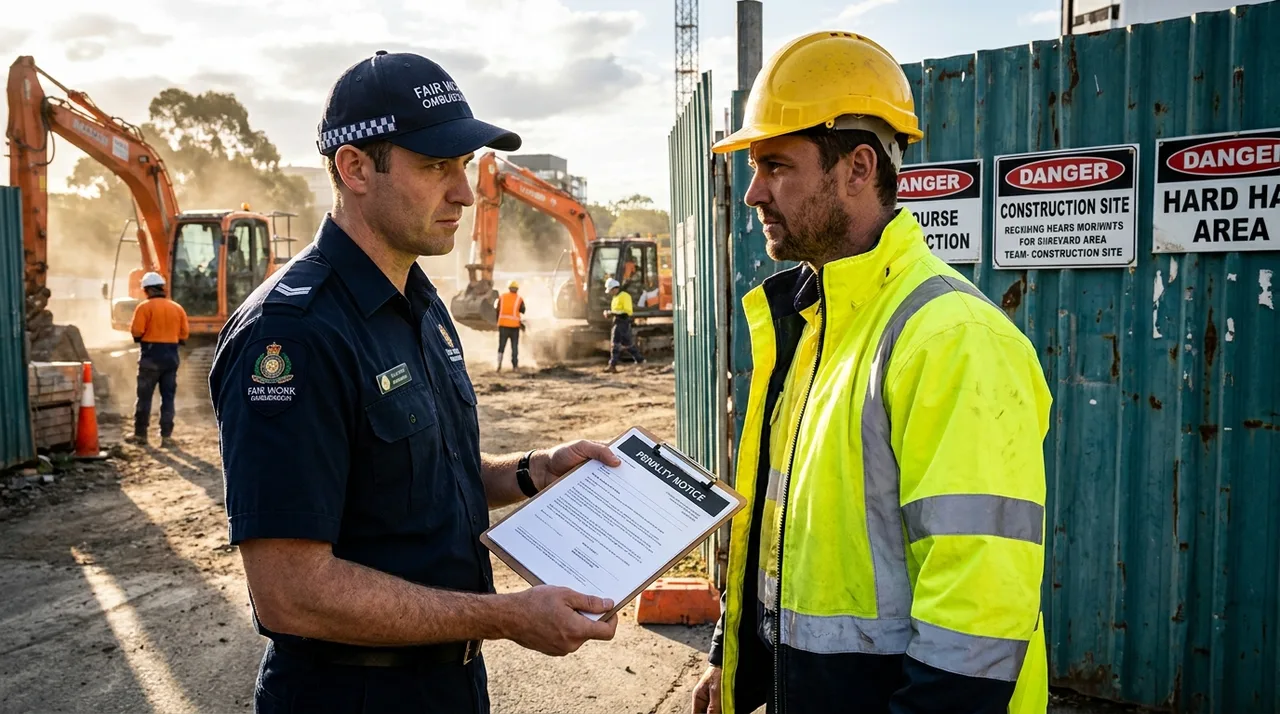
Notice something in the ProClean case. The Fair Work Ombudsman investigated after the company responsible for maintenance operations at the Auburn Maintenance Centre contacted the FWO with concerns that workers were being underpaid.
The principal flagged it. Smart move — it kept them out of the firing line. The Fair Work Ombudsman makes no allegations against Sydney Trains or any other company involved in the operation of the maintenance centre.
Builders that don't flag it — that look the other way while their subbie chains use sham labour — don't get the same protection. Accessorial liability provisions in the Fair Work Act mean a knowing principal can be dragged in.
This is exactly why host employer responsibilities sit at the centre of every compliant labour hire conversation.
How the Closing Loopholes Act 2024 changed the rules
For years, builders relied on a written contract that said "independent contractor" to defend any FWO challenge. The High Court backed that approach in 2022. The Closing Loopholes Act burnt the playbook.
The penalty hike — five-fold
From 27 February 2024, there will be a five-fold increase in the maximum civil penalties that courts may impose for underpayments and sham contracting, rising to $469,500. These penalties can apply against companies that are not small business employers.
For systemic abuse, the bar for "serious contraventions" was lowered to cover knowing and reckless breaches — and the penalty climbs to $4,695,000 per contravention for a body corporate.
The 'real substance' test
This is the change that catches construction principals flat-footed. Section 15AA of the Fair Work Act now requires the "real substance, practical reality, and true nature" of the relationship to be considered, not just the contract. This means looking at how the work is actually performed: Does the worker control how, when, and where the work is done?
The contract is no longer the shield. The site is. A court will now look at how your subbie actually works on your site — not what the agreement says.
The 'reasonable belief' defence
The other big shift. The previous requisite 'recklessness' test that had to be established for a defence against sham contracting has been replaced by a test of 'reasonableness'. To defend a sham contracting claim, an employer must now prove that at the time the representation was made they reasonably believed the worker was engaged as a contractor.
You now have to prove you reasonably believed the arrangement was genuine. Factors to support this defence include the size and nature of the employer's business, and whether the employer acted on or sought legal advice prior to entering the contract.
A scribbled ABN on a timesheet won't cut it.
How a compliant labour hire agency shields the host
Time to be honest about what we do.
Leap Labour is a labour hire company. We supply construction and warehouse crews to Sydney sites. We're not a neutral commentator. But the structure of compliant labour hire is exactly what the FWO and ATO want to see — and that's not marketing, it's how the law reads.
When you engage a worker through a compliant labour hire agency, the agency is the employer of record. The worker is on PAYG. Super is paid. Workers comp is in place. Single Touch Payroll runs every cycle. The ATO sees it. The FWO sees it. The worker sees it on their payslip.
That's the opposite of the sham subbie model.
Where the legal liability actually sits
In a compliant labour hire arrangement, the agency carries the employer obligations. The host (you) provides direction on what work needs doing. Both parties have clear, separable duties under the host employer responsibilities framework that SafeWork NSW publishes.
Compare that to a sham subbie chain:
The "subbie is cheaper" argument falls apart the moment the FWO opens a file. The maths of labour hire cost breakdown shows the true comparison when super, leave loading, workers comp and payroll tax are properly costed in.
What the ATO actually wants to see
Sham contracting is primarily an issue of compliance with workplace relations laws. Key drivers of these arrangements are tax, wage and condition avoidance, particularly for employers to avoid PAYG withholding, super guarantee payments, and award and agreement-based penalties and allowances.
A compliant labour hire agency removes every one of those drivers. PAYG withheld — tick. Super paid — tick. Award rates applied under the Building and Construction General On-site Award — tick. The ATO and FWO have no missing money to chase.
This doesn't mean a labour hire arrangement is bulletproof. It means the structure is built to comply. The compliance still has to be real — which is why compliant labour hire in Sydney is a conversation about audits, payslips and worker treatment, not just paperwork. See also labour hire Sydney transparency for the questions to ask any supplier.
Red flags on your own site — a self-audit
Run this honestly. If the answer to two or more of these is "yeah, that sounds like our place," your build has exposure.
The construction industry has known this is coming for two years. The Australian Taxation Office (ATO) and the Fair Work Ombudsman (FWO) have announced they are ramping up their focus on sham contracting. CCF NSW encourages our members to consider their contractual relationships with their workers to ensure they are all lawful and appropriate. Even the Civil Contractors Federation NSW is telling members to clean up.
The supplier conversation to have this week
Ring your labour suppliers. Ask three questions.
- Are the workers on your site PAYG employees of yours, or ABN subbies?
- Can you send me a redacted payslip showing super and award rates for one worker placed with us?
- Do you carry workers compensation that covers them on my site?
A compliant labour hire agency answers all three in one email. A sham subbie supplier dodges, deflects, or asks why you're asking.
The Fair Work Ombudsman publishes guidance on what to do if you suspect sham contracting in your supply chain. The fairwork.gov.au sham contracting page is the starting point. The ATO's sham contracting page covers the tax side.
If you're rebuilding your supplier mix, the difference between labour hire vs recruitment agency matters — only labour hire keeps the worker as the agency's employee, which is the structural protection we're talking about.

Frequently Asked Questions
What is sham contracting in plain English?+
Sham contracting is when a business calls a worker a subcontractor but treats them like an employee — setting their hours, supervising them, telling them what tools to use. The label on the invoice doesn't match the reality on site. Section 15AA of the Fair Work Act 2009 (Cth) ("Act") confirms that "the real substance, practical reality and true nature of the relationship" between the parties is determinative when assessing whether an employment relationship arises.
Can a head builder get penalised for a subbie's sham arrangement?+
Yes. The FWO and ATO routinely pull principals into investigations through Shadow Economy Taskforce data-matching, TPAR reports, and worker tip-offs. The FWO is one of 11 government agencies involved in the SET and has various compliance and enforcement powers to act on suspected sham contracting. Taxable payments annual reporting data is also being utilised to identify contractors who work almost exclusively for one business – a factor which commonly suggests that a working relationship is more likely to be that of employment. If a worker on your site is misclassified and you knew or should have known, your business is in the frame for accessorial liability, back-pay, and reputational damage.
What are the maximum penalties for sham contracting in 2026?+
The Fair Work Act imposes strong penalties for sham contracting, with courts able to impose penalties up to $19,800 for individuals, $99,000 for businesses operating with 15 or fewer employees, and for larger businesses, the greater of either $495,000 or three times the underpayment amount. Serious contraventions for corporations can reach $4,695,000 per breach under the Closing Loopholes No.2 Act 2024.
How does compliant labour hire protect my site?+
A compliant labour hire agency engages workers as PAYG employees, pays superannuation, holds workers compensation, and runs payroll through Single Touch Payroll. The agency is the employer of record. Your site gets the crew — concreters, formworkers, dogmen, traffic controllers, pickers — without inheriting the misclassification risk that comes with cash-in-hand "subbies" on an ABN. The structure removes the drivers regulators target: tax, wage and condition avoidance, particularly for employers to avoid PAYG withholding, super guarantee payments, and award and agreement-based penalties and allowances.
What's the difference between a real subcontractor and a sham one?+
A genuine subcontractor runs their own business — quotes the job, brings their own tools and insurance, controls how the work is done, can subcontract to others, and works for multiple clients. A sham subbie works set hours under your supervisor, uses your tools, can't send a replacement, and invoices only your business. The ATO identifies sham contracting warning signs including contractors who work almost exclusively for one business and individuals operating with an ABN but failing to declare their income or lodge their tax returns.
What does the Closing Loopholes Act change for builders?+
From 26 August 2024, the Fair Work Act's new section 15AA requires the "real substance, practical reality and true nature" of the working relationship to be considered — not just the contract terms. The previous requisite 'recklessness' test that had to be established for a defence against sham contracting has been replaced by a test of 'reasonableness'. To defend a sham contracting claim, an employer must now prove that at the time the representation was made they reasonably believed the worker was engaged as a contractor. Penalties also jumped five-fold, to $469,500 per contravention for corporates.
Get the right crew on site — without the risk
The FWO crackdown isn't a future problem. It's a current one. The ATO and Fair Work Ombudsman are ramping up their focus on sham contracting, with a number of investigations already underway in sectors such as building and construction.
The fix isn't complicated. Stop using suppliers who push ABN "subbies" onto your site. Use a labour hire agency that runs every worker as a PAYG employee, pays super, carries workers comp, and gives you the payslip when you ask.
That's what we do at Leap Labour. Concreters, formworkers, dogmen, traffic controllers, labourers, forklift operators, pickers. Names in your inbox. Crews confirmed by arvo. Payslips on request. No ABN nonsense.
If you want to swap one or two trades over to a compliant supply this month — pilot run, no commitment — send the job specs and the start date. We'll come back with names and rates the same day.
For more on the compliance picture, see our pillar on compliant labour hire in Sydney. If you're weighing the cost question honestly, is labour hire worth it and the labour hire cost breakdown lay out the real numbers. If you'd rather convert a strong worker to your own books later, hiring a labour hire worker permanently walks through how that works.
Sham subbies are the cheapest crew on the rate sheet — until the FWO knocks. Compliant labour hire is the cheapest crew once the full cost is on the table.
Your call. Our crews are ready.