
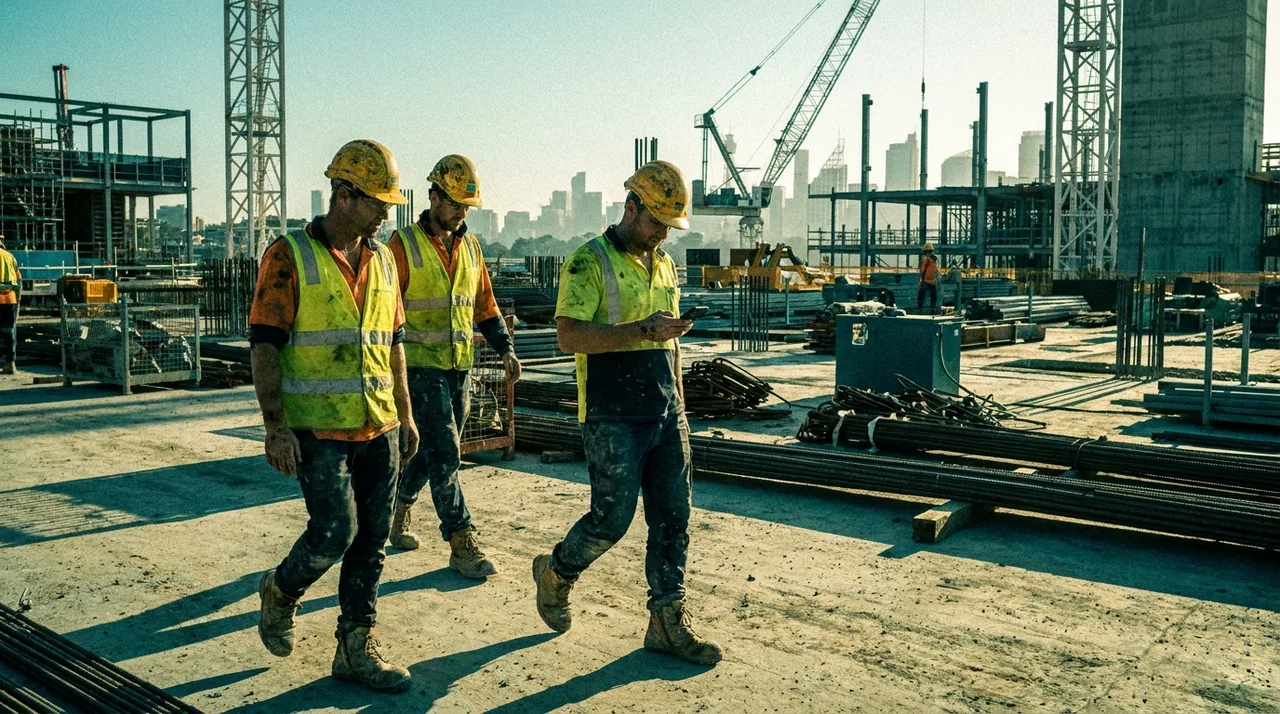
Inside a 24-Hour Crew Allocation: From 3pm Call to 7am Start
Hour-by-hour walkthrough of how a Sydney labour hire crew gets allocated, verified, and on site by 7am — the operational depth behind every booking.
A 24-hour crew allocation cycle gets verified workers on a Sydney site by 7am from a 3pm booking call — not random phone calls, but a structured process with eight steps.
- 3pm — ticket logged: role, count, address, start time, duration captured in under 3 minutes
- 3–4:30pm — pool match: 200+ workers filtered by role, geography, availability, credentials
- 4:30–6pm — outbound and re-verification: shortlist contacted, White Cards checked against Verify NSW
- 6–7pm — client confirmation email: worker names, credentials, contacts in your inbox by knock-off
- 7–9pm — backups briefed: standby workers given full site details in case of no-show
- 5am — wake-up SMS: confirmation messages sent; non-responders called by 5:45am
- 6am — backup deploy: no-show flagged, standby activated, on the road by 6:15am
- 7am — supervisor handoff: induction, PPE check, work starts
3:04pm. Your site manager rings. Two skilled tradesmen needed at Alexandria by 7am tomorrow. Concrete pour at 8. Urgent.
You hang up. Sixteen hours later, two blokes walk through the gate with White Cards out and boots laced. Names already in your inbox the night before. Supervisor knows who to brief.
What happened in between isn't magic. It isn't random calls down a list either. It's a structured allocation cycle with verification gates, geography filters, and backup logic — the kind of operational depth most builders don't see because it runs behind the curtain.
This article opens the curtain. Hour by hour. From the 3pm call to the 7am start.
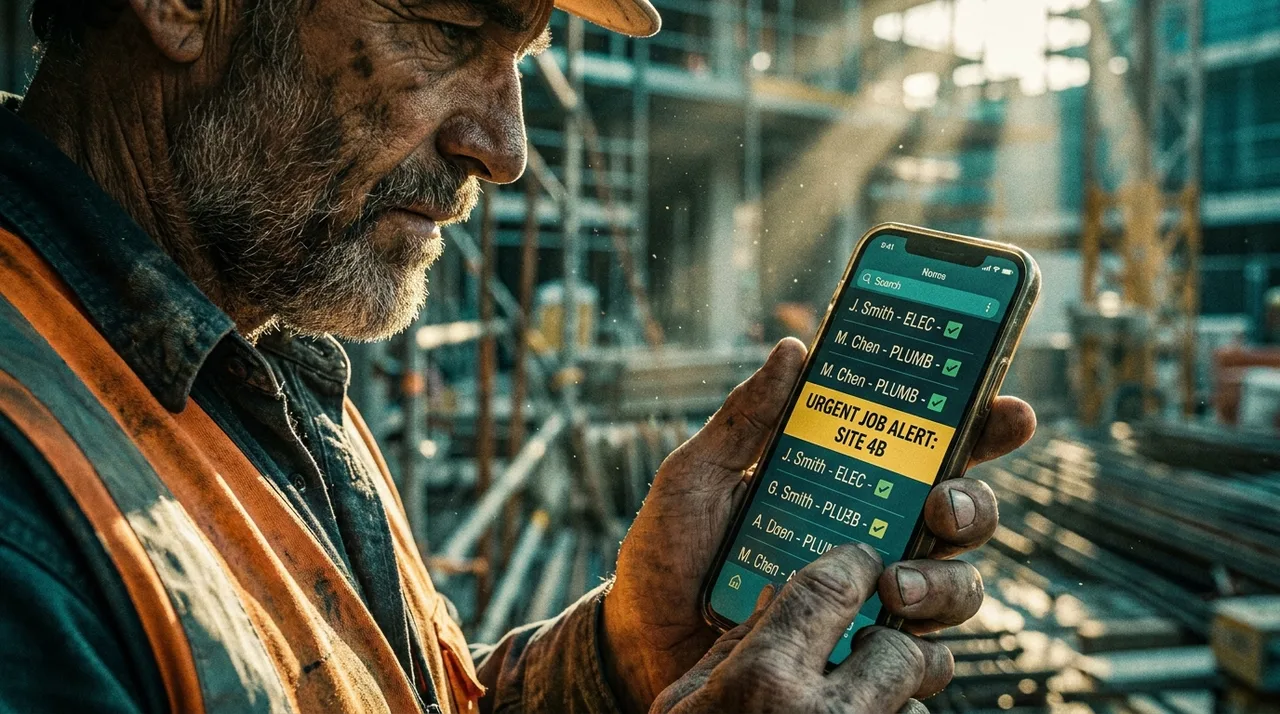
Table of Contents
- The 3pm Call: What Gets Logged
- 3pm to 4:30pm: Matching Against the Pool
- 4:30pm to 6pm: Outbound and Re-Verification
- 6pm to 7pm: Client Confirmation Email
- 7pm to 5am: Backups, Wake-Ups, No-Show Checks
- 6am to 7am: Deployment and Handoff
- The Myth: "It's Just Calling Random Workers"
- In-House vs Agency: What You'd Have to Replicate
The 3pm Call: What Gets Logged
Every cycle starts the same way. Phone rings. Site manager on the other end. The conversation is short — usually under three minutes.
Four data points get captured before you hang up:
- Role and count. Not "labourers" — two concreters and one rigger. Specificity drives matching.
- Site address. Suburb-level isn't enough. Full street address determines travel time filters.
- Start time. 7am is standard. 6am means earlier wake-up calls and tighter overnight windows.
- Duration. One day, one week, ongoing. Affects which workers get offered the gig.
A supervisor contact number is the bonus fifth field. It saves a phone call at 6:45am when the new starter can't find the gate.
What you should give us at 3pm: role (e.g. concreters, riggers, licensed scaffolders), count, address, start time, duration, supervisor contact. That's it. PPE specifics, induction logistics, and parking notes can flow through the confirmation email at 7pm.
The ticket gets logged immediately. From this moment, the clock runs. Sixteen hours to a crew on site.
3pm to 4:30pm: Matching Against the Pool
This is where the structured part begins. The pool — a roster of verified, vetted, available workers — gets filtered through five layers in sequence.
Layer 1: Role match
Concreters get matched to concreting jobs. Riggers to crane and rigging work. Dogmen to dogging. Sounds obvious. It isn't always — a "skilled labourer" request to one builder means a concreter, to another it means a trade assistant, to another it means a licensed scaffolder. The role filter pulls workers whose recent history and credentials match the actual task.
AI-assisted order management: When an urgent booking lands, an AI layer instantly parses the role, count, and site address — flags it as urgent if the window is under 8 hours — and pre-ranks the pool before a human allocator opens the shortlist. The allocator reviews, adjusts if needed, and confirms. Faster filtering, same human sign-off.
Layer 2: Geography
A worker living in Penrith won't reliably make a 7am start in Alexandria via public transport. Geography filters apply realistic travel-time bands — typically a 60-minute commute ceiling for early starts. Workers outside that band get deprioritised, not excluded entirely.
Layer 3: Current bookings
Workers already on multi-day jobs are filtered out. So are workers who finished a night shift at 6am that morning — fatigue management isn't optional. The primary duty of care under WHS law sits between the labour hire agency and the host employer, and assumptions that someone else handles safety create gaps. Sending a knackered worker to a 7am start fails both duties.
Layer 4: Recent performance
Workers with recent no-shows, late arrivals, or supervisor complaints drop down the list. Workers with strong feedback from previous hosts move up. This isn't a black mark forever — patterns matter more than single incidents.
Layer 5: Expired credentials
This is the gate that kills bookings if it's skipped. SafeWork NSW maintains a register of high risk work licence holders, asbestos and demolition licence holders, and general construction induction training card holders, designed so businesses can check the validity of workers' licences and make informed decisions. A White Card valid six months ago may have lapsed if the worker stepped out of construction for over two years. Cards from any jurisdiction are only regarded as valid provided the holder has not been out of the industry for more than two years per clause 316 of the WHS Regulation.
The matching engine flags any credential within 30 days of expiry. Those workers don't get offered the job until they've renewed.
By 4:30pm, the pool of 200+ workers has narrowed to a shortlist of 6 to 10 strong candidates.
4:30pm to 6pm: Outbound and Re-Verification
The shortlist gets contacted in priority order. Phone first, SMS as backup. The conversation is short — three questions:
- Are you available for a 7am start tomorrow at [address]?
- Can you confirm your transport works for that time?
- What's the status of your White Card / High Risk Work Licence?
Question three triggers the re-verification gate. Even though the pool record shows current credentials, the system checks again. Verify NSW is the live public register where high risk work licence numbers and details can be checked. A licence that was current at the last booking may have been suspended or cancelled in the interim.
For White Card holders, the same applies. The register includes the licence/card holder's name, licence number and type, licence status, the licence expiry date (if any), licence conditions, prosecution summaries and information about any penalty notices issued.
For high-risk roles — forklift operators, dogmen, riggers, scaffolders — the HRWL class gets matched against the actual task. A worker with an LF (forklift) ticket isn't automatically cleared for a CN (non-slewing crane) job. Class-specific verification matters.
If you want to dig into the licence categories themselves, forklift licence types in NSW breaks down what each class covers.
By 6pm, two confirmed workers are locked in. Site address has been sent. Supervisor's mobile number has been sent. The workers know where they're going, who they're meeting, and what time the gate opens.
6pm to 7pm: Client Confirmation Email
Names in your inbox by knock-off.
The confirmation email is short by design. You don't need a thesis at 6:45pm. You need:
- Worker names — full names, so the supervisor can recognise them at the gate.
- Start time — confirmed, not assumed.
- Contact numbers — direct mobiles, in case anyone's running late.
- Credential summary — White Card numbers, HRWL class if relevant.
- Booking reference — for the timesheet later in the week.
That's the whole email. No marketing, no upsell, no "we appreciate your business" boilerplate. Information dense, scannable, done.
If you've ever had to chase a labour hire agency at 7am to ask "who's actually coming?" — that's the failure mode this email exists to prevent.
7pm to 5am: Backups, Wake-Ups, No-Show Checks
This is the part most clients don't realise happens.
7pm to 9pm: Backups briefed
Two confirmed workers isn't enough. Two backup candidates from the original shortlist get a separate call. The conversation is different:
"You're on standby for a 7am start tomorrow at Alexandria. Primary crew is locked in. If something falls over by 6am, we'll deploy you. Sit by the phone."
Backups know the site address, the supervisor contact, and the role. If they're activated at 6am, they're not starting from zero — they've already mentally scheduled the day.
A backup worker who's properly briefed at 8pm is worlds different from a worker called cold at 6am.
5am: Wake-up SMS
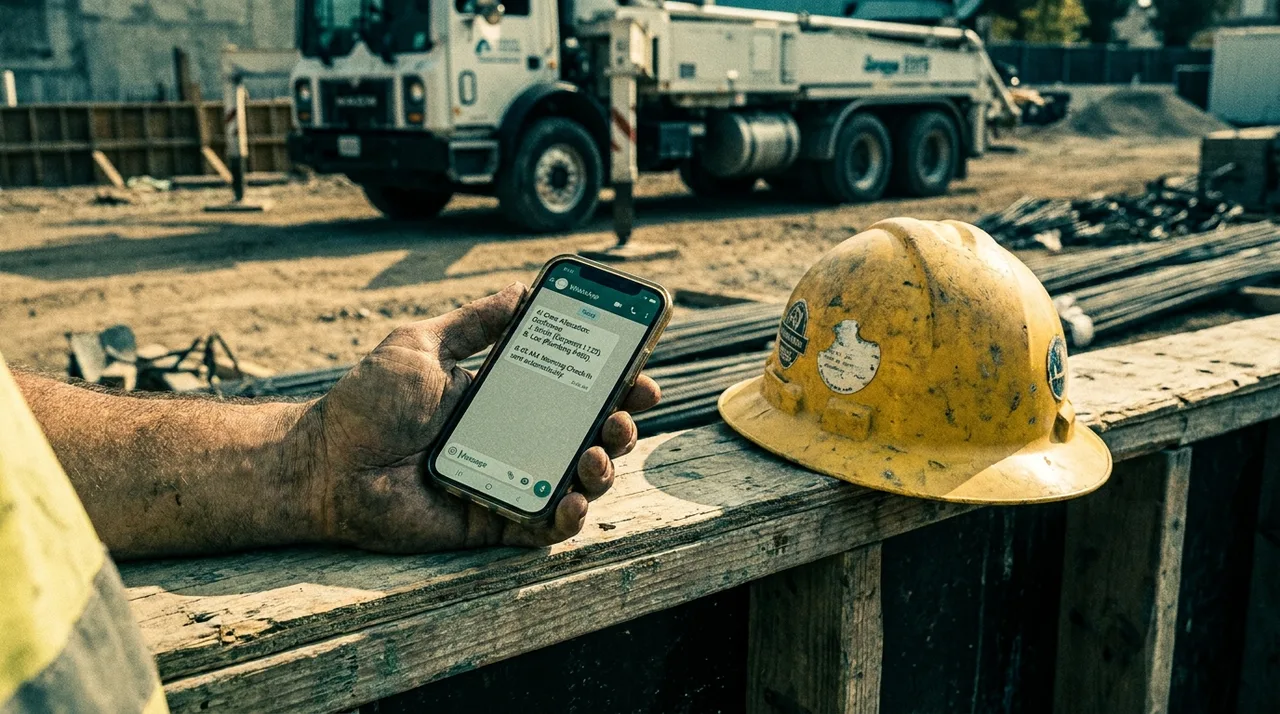
An automated SMS goes out to confirmed workers at 5am: "Confirming your 7am start at [address]. Reply YES to confirm."
Most workers reply within 15 minutes. They've got alarms. They're up making coffee.
The ones who don't reply by 5:45am get a phone call. If the phone rings out twice, the no-show flag triggers.
6am: No-show deployment
If a primary worker is flagged as no-show, the standby worker gets the activation call. They've been briefed since 8pm last night. They know the address, the supervisor, the role.
The window from no-show flag to backup deployment is typically 15 minutes. The backup is on the road by 6:15am for a 7am start.
This is why the backup briefing at 8pm matters more than the wake-up SMS at 5am. The wake-up just surfaces the problem. The briefing is what makes the solution actually work.
Why two backups, not one? Statistically, primary no-show rates run around 3-5% for early starts. Backup no-show rates are lower because backups self-select for reliability. But two backups gives redundancy on the redundancy. For a 5-worker booking, expect 2-3 backups primed.
6am to 7am: Deployment and Handoff
By 6:30am, the picture is clear. Either both primary workers confirmed (most days), or a backup got activated (some days), or — rarely — a second backup got pulled in.
Workers arrive at the gate between 6:45am and 7am. The supervisor introduces them. Site induction happens — every site, every time. A safety induction is required each time a worker starts on a new construction site.
This is a host employer responsibility, not a labour hire one. Workers are affected by decisions that host employers make and must be involved in WHS decisions, with labour hire workers having the same consultation rights as other workers, and effective consultation between the agency, host employer and worker being fundamental to securing safety rights.
The handoff itself is short:
- Supervisor briefs the worker on the day's task.
- Worker signs the site induction register.
- PPE checked — boots, hi-vis, hard hat, glasses, gloves.
- Worker shown to the start point.
By 7:05am, the crew is working. The supervisor has the worker's mobile. The worker has the supervisor's mobile. If anything wobbles during the day, both sides can talk directly.
AI-assisted morning check: At 7:30am, an automated check-in goes out to each deployed worker. If a worker doesn't respond within 20 minutes, the allocator gets an alert. The allocator calls the site supervisor to confirm the worker arrived safely. It's not surveillance — it's a safety net that catches the rare case where a worker made it to site but something went sideways.
For a full breakdown of what host employers carry once the worker walks through the gate, host employer responsibilities covers the WHS, induction, and consultation duties in detail.
The Myth: "Labour Hire Is Just Calling Random Workers"
This is the assumption a lot of builders carry into their first labour hire booking. It's not unreasonable — from outside, it looks like a phone-and-spreadsheet operation.
It isn't.
The 16-hour cycle described above involves at least nine distinct steps, four verification gates, two layers of redundancy, and a database of pre-vetted workers numbering in the hundreds. Drop any one of those and the system breaks.
| Myth | Reality |
|---|---|
| "You just call your mate down the street" | Pool of 200+ pre-vetted workers, filtered five ways |
| "White Card check is a one-time thing" | Re-verified every booking against Verify NSW |
| "If someone doesn't show, you scramble" | Backups briefed the night before, activated by 6:15am |
| "The 7am start is luck" | The 7am start is the output of a 16-hour structured cycle |
| "Anyone can do this in-house" | Anyone can — most builders calculate it costs more than the agency margin |
The "calling random workers" model exists. It's how some agencies operate. The result is what you'd expect: no-shows, expired tickets turning up at the gate, no backups when things wobble, and the host employer wearing the WHS exposure when it goes wrong.
Compliant labour hire isn't a phone-and-spreadsheet operation. Compliant labour hire in Sydney covers what separates the structured operators from the rest.
In-House vs Agency: What You'd Have to Replicate
Some builders do run labour allocation in-house. It works for some — usually those with steady, predictable headcount needs and a dedicated coordinator role.
For builders evaluating in-house vs agency, here's the operational depth you'd be replicating:
The pool
A list of 200+ verified workers across roles. Maintained, contacted weekly, kept warm. Workers who aren't called regularly drift to other agencies. The pool is a living thing — not a spreadsheet from 2023.
The verification infrastructure
Every booking, every worker. White Cards checked against Verify NSW. HRWLs checked against the SafeWork register. Class matched to task. A High-Risk Work Licence must be renewed every five years and is required by SafeWork NSW to operate machinery, work with scaffolding and undertake rigging. Renewal lapses happen — the system catches them before the worker hits the gate.
The comms tooling
SMS automation for wake-ups. Phone systems for outbound at scale. Ticketing for booking management. CRM for worker records. None of this is exotic, but it's not free either — and it's not maintenance-free.
Payroll and compliance
Workers get paid. Super gets paid. Workers comp gets paid. PAYG gets withheld. Labour hire workers are employed by the labour hire agency, not the host employer to whom they provide labour. The agency wears the employer obligations — payroll, super, workers comp, and Fair Work compliance.
Backup logic
The 6am no-show response. This is the part most in-house operations underestimate. It's the difference between a 3% disruption rate and a 15% disruption rate.
The honest answer for most builders: in-house works for predictable, steady headcount. Agency works for surge, short-term, and roles you don't want to carry overhead on. Many builders run both.
For a deeper dive on the cost side, is labour hire worth it walks through the maths. And labour hire cost breakdown shows where the agency margin actually goes.
We Are a Labour Hire Company
Worth saying plainly: Leap Labour is a labour hire company. The cycle described in this article is what we do every weekday. We're not pretending to be neutral about whether it's worth using a labour hire agency — we run one.
What we can be honest about:
- The cycle works because it's structured, not because it's secret. Any well-run agency operates similarly.
- In-house allocation works for some builders. We've worked alongside builders who run both models.
- The verification gates exist because skipping them creates real liability — for both the agency and the host employer.
If you're weighing labour hire against direct hire or a recruitment agency, labour hire vs recruitment agency covers the differences in obligation and cost structure.
Frequently Asked Questions
How late can I call and still get a crew on site by 7am the next morning?+
A 3pm call gives the full 16-hour cycle for matching, verification, and confirmation. Calls up to around 6pm are workable for next-day starts. After 8pm, the candidate pool shrinks because workers have gone to bed for early starts and verification windows compress. For genuine same-day or sub-12-hour requests, AI-assisted instant replies help compress the front end of the cycle.
What happens if a worker doesn't show up at 7am?+
A 5am wake-up SMS flags no-shows before they become problems. If a worker doesn't confirm by 6am, a backup candidate from the standby pool is deployed. Backups were briefed the night before with the site address and supervisor contact — they're not starting from zero. Typical activation-to-on-site window is 45-60 minutes, so a backup deployed at 6:15am is on site by 7-7:15am.
Do you actually verify White Cards and High Risk Work Licences every booking?+
Yes. Every allocation runs a re-verification check against SafeWork NSW's Verify NSW register. A card valid six months ago may have lapsed, been suspended, or been cancelled. Cards from any jurisdiction are only regarded as valid provided the holder has not been out of the industry for more than two years. Workers with expired credentials are filtered out before they reach the shortlist.
Why not just keep a casual list and call workers directly ourselves?+
You can — many builders do. The cost is the operational depth: maintaining a pool of 200+ verified workers, running geography and credential filters, handling no-show backups at 6am, payroll, super, workers comp, and Fair Work compliance. For occasional needs, in-house works. For weekly volume, the hours add up fast. Labour hire cost breakdown walks through where the margin goes.
What information do you need from me at 3pm to start the cycle?+
Four things: role and count (e.g. two concreters, one rigger), site address, start time, and expected duration. A supervisor contact number helps. Anything else — site inductions, PPE specifics, parking — gets folded into the confirmation email by 7pm. The faster the four core fields land, the longer the matching window.
Get Started
If your site needs a crew confirmed by knock-off for a 7am start tomorrow, the cycle works the same way every time. Call by 3pm. Give us role, count, address, start time, and duration. Names land in your inbox by 7pm. Backups primed by 9pm. Wake-up SMS at 5am. Crew on site at 7am.
That's what you're paying for. Not the workers — you'd find workers eventually. The 16-hour structured cycle that gets them on site, verified, and ready to start when the gate opens.
Useful next reads:
- Compliant labour hire in Sydney — what separates structured operators from cowboys
- Host employer responsibilities — what you carry once the worker walks through the gate
- Skilled vs general labourer — how role specificity drives matching
- Labour hire Sydney transparency — the parent pillar with the full picture
External references:
- SafeWork NSW — White cards
- SafeWork NSW — High risk work licences
- SafeWork NSW — Labour hire toolkit
- Fair Work Ombudsman — Labour hire and supply chains
Ring us. The cycle starts when the call lands.