
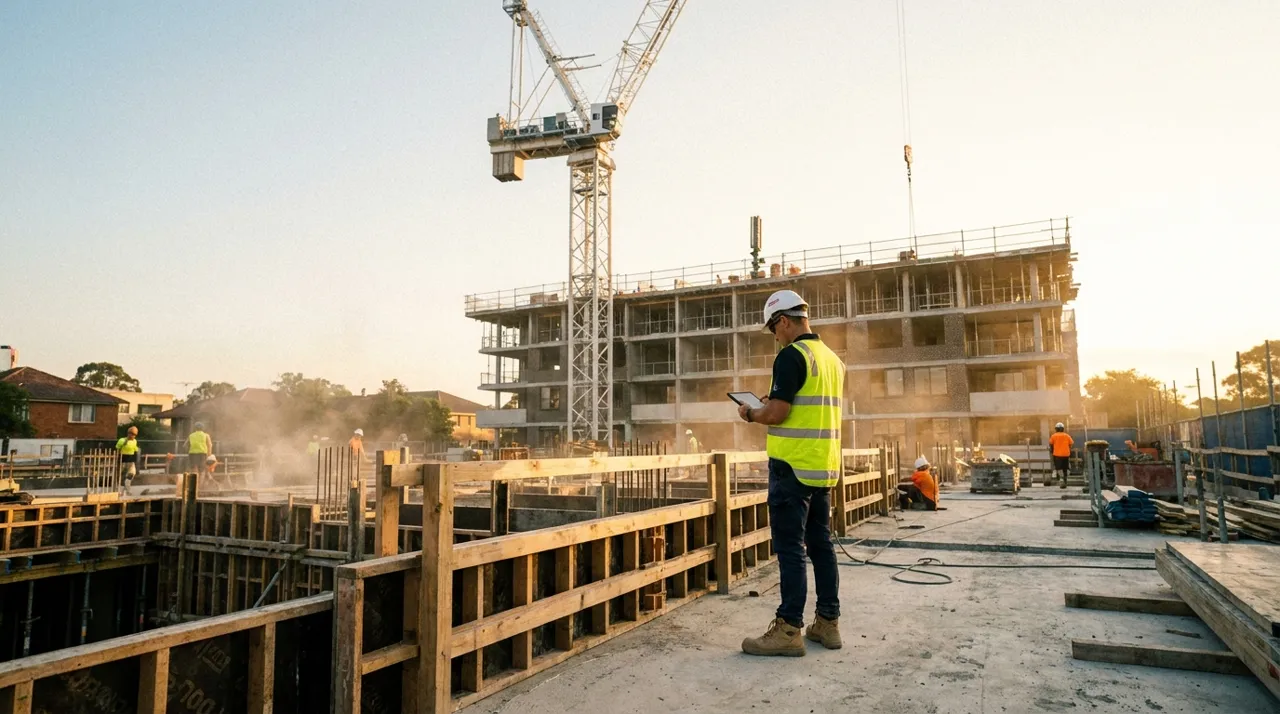
Coming to Australia to Work in Construction (2026): The Honest Guide
An honest guide for anyone outside Australia thinking about coming here to work construction. What the Working Holiday visa, Work and Holiday visa and Student visa actually feel like day to day, what your first weeks look like, what the work and the site culture are really like, and the traps to see coming.
Coming to Australia to work construction is realistic. It is also less glamorous and more physical than the videos make it look.
- The common front door is the Working Holiday visa (subclass 417) or the Work and Holiday visa (subclass 462). Your passport decides which one you can apply for
- The Student visa (subclass 500) carries work rights too, but they are capped while your course is running, which shapes the shifts you can take
- The sponsored route (the Skills in Demand visa, subclass 482) is what people hope for. Almost nobody starts there
- Before any site: tax file number, Australian bank account, Australian phone number, and a White Card
- Expect to start as a labourer whatever you did at home, and expect early starts
- Permanent residency is possible, slow, and conditional. Read the dedicated guides before you plan your life around it
- Your own conditions are written on your grant letter, and they are not the same for everyone
You are on the other side of the world, reading about a country you have never worked in, trying to work out if the whole thing is real.
It is real. People land here every week with two bags and a visa, and they are on a site inside a fortnight. It is also 5:30am starts, 35 degree days, and rent that eats a third of what you earn.
This is the honest version. Not the migration brochure. What each route feels like day to day, what your first weeks look like, what the work and the culture are really like, and what to watch out for.
This is not immigration advice. For your own situation, read your grant letter, check immi.homeaffairs.gov.au, and if it is complicated, talk to a MARA-registered migration agent.
Table of Contents
- Which Visas Actually Get You Onto an Australian Site
- What the Working Holiday and Work and Holiday Visas Feel Like
- What Life Is Like on the Student Visa
- The Sponsored Route: What People Hope For
- Your First Three Weeks in Australia (2026)
- What the Work Is Actually Like
- The Culture on an Australian Site
- The Traps, Stated Plainly
- Can This Lead to Permanent Residency?
- Is It Worth Coming?
Which Visas Actually Get You Onto an Australian Site
There is no construction visa. There are visas that carry work rights, and construction is one of the things you can do with them.
Three routes cover almost everybody who ends up on a site:
- The Working Holiday visa (subclass 417) and the Work and Holiday visa (subclass 462), which are the common front door
- The Student visa (subclass 500), where work is the side, not the main event
- The Skills in Demand visa (subclass 482), the sponsored route, which is where people hope to end up rather than where they start
Blunt, and the most useful thing anyone will tell you. Site supervisors are not immigration officers. They want a White Card, a name they can rely on, and a person who is there at 6:30am.
The visa only starts to matter when the question changes from can I work to can I stay.
What the Working Holiday and Work and Holiday Visas Feel Like
These two are the reason most overseas workers end up in Australian construction at all. They are separate visas with separate lists of countries, not two names for the same thing, and your passport decides which one you can apply for. We break them apart properly in the Working Holiday vs Work and Holiday visa guide.
The rhythm of the year
The year has a shape, and almost everyone lives the same one.
Months one and two are setup and scramble. You land, you sort your paperwork, you get your White Card, you take whatever shifts you can get. You are probably in a hostel or a share house and you are probably spending more than you are earning.
Months three to eight are the good part. You are known somewhere. Your phone rings for shifts instead of you chasing them. You have picked up a ticket or two beyond the White Card. You have money coming in and you have started seeing the country on your days off.
Months nine to twelve are the decision. Do you extend, do you go home, do you change direction. This is where people who planned early are calm and people who did not are panicking.
The people who have a bad working holiday are almost always the ones who left every decision to month eleven.
How employers see these visas
They are used to them, with one reservation.
The good: you can work, you are usually keen, you show up. Labour hire agencies and site managers place people on these visas constantly. This is a normal part of how Australian construction is staffed, not a fringe thing.
The reservation: everyone knows you are temporary. That is fine for labouring and general site work, where the job is the job. It matters more if you want a site to train you up or hand you responsibility. Some will. Many quietly give the long-term work to someone who is going to be around.
What work you will realistically get
- General labouring: clean-up, materials, dig, carry, assist. This is where nearly everyone starts
- Trade assistant work: offsiding for a carpenter, concreter, formworker or scaffolder. This is where it gets more interesting and better paid
- Ticketed work: traffic control, elevated work platforms, and other tickets you can add once you are here and earning
- Your actual trade from home: possible, but usually later, and often after an Australian site has watched you work
There is also a limit on how long you can keep working for the same employer on these visas. It is written as a condition on your visa. Read your grant letter, know your own condition, and ask your employer how they track it rather than discovering it late.
What Life Is Like on the Student Visa
The Student visa (subclass 500) is a different life. Study is the obligation. Work fits around it.
Your work rights are capped while your course is in session, and that single fact shapes your whole week.
What the cap does to your week
Construction does not run on flexible little shifts. It runs on full days that start early. A site does not need you for three hours on a Tuesday afternoon.
So the cap pushes you toward:
- Weekend work, which sites do run, though not every week
- Shorter site jobs and clean-up work rather than being part of a core crew
- Full-time shifts during course breaks, when your cap is different
How employers see it
More cautiously, and not because anyone dislikes students. It is logistics. A supervisor building a crew for a six-week programme wants people who can be there every day of it.
Be upfront about your availability from the first conversation. An honest "I can do Saturdays and every day of the semester break" gets you work. A vague answer that turns into a no-show does not.
The hours cap is a visa condition, not a company policy. Exceeding it is your risk, not your employer's. Anyone telling you the extra hours will not be noticed is playing with your visa, not theirs.
The Sponsored Route: What People Hope For
The Skills in Demand visa (subclass 482) is the one everybody has heard of. It replaced the old Temporary Skill Shortage visa on 7 December 2024.
The mechanism, stripped of the mythology: an Australian business that has been approved as a sponsor nominates you for a specific occupation, because it needs your particular skills. The business carries the paperwork, the cost, and the obligations. You are attached to that arrangement.
Which is exactly why it is rarely a starting point.
A business sponsors you when it has already decided it wants you specifically. Not a worker. You. That decision usually comes after someone has seen you work, which means it comes after you are already here.
It is rarer still in labour hire: a general labour supplier struggles to explain why it needs you rather than the next person in its pool. Specialist trade employers with a genuine skills gap have a stronger case. What has to be proven is in the Sydney tradie sponsorship guide.
Sponsorship is something you might earn after a year of being good. It is not a plan you fly in on.How to hold the sponsored route in your head:
- It is real, and construction workers do get sponsored
- It depends on your occupation and on the employer being an approved sponsor
- Occupation lists, salary requirements and streams change. Do not memorise a forum version
- Check the current requirements at Home Affairs before you plan around it
Your First Three Weeks in Australia (2026)
Here is the order that actually matters on the ground. Not the order the government website implies, the order that gets you earning.
The White Card is the gate. People burn a week discovering this. Everything else on that list can be half-done and you still get through the day. Without a White Card you do not get past the site fence, because it is the supervisor's licence and liability, not just yours. The fuller ground game is in the first Sydney construction job guide.
You start as a labourer. All of you.
It does not matter that you ran a crew of eight at home, or that you have twelve years on the tools. Australian sites work to Australian methods, materials, safety rules and paperwork, and nobody knows you yet.
Your experience is not lost. It is just not yet visible. Most people who arrive with real skills are doing something better within three months, because it shows.So take the labouring start and do it well. Skilled hands are obvious within about two days, and the people who move up fastest are the ones who did not spend a fortnight telling everyone how experienced they were.
The money question, honestly
Construction pay in Australia is set by the Building and Construction General On-site Award (MA000020) or by a site agreement, on top of which your employer pays superannuation, which has been 12 per cent of your ordinary earnings since 1 July 2025. Casual work also attracts a loading on top of the base rate.
That is decent money by most countries' standards. Then Sydney happens.
Rent is the thing that shocks people. A share room, transport, and food will take a serious share of a labourer's pay in this city, and the first month is the worst because you are paying bonds and buying boots before you have been paid. Arrive with a buffer if you possibly can.
For what actually lands in your account after tax and what the deductions mean, read the Sydney labourer pay guide.
What the Work Is Actually Like
The hours
Early. Australian sites commonly start around 7am, which means being there before that, which means an alarm between 4:45am and 5:30am depending on how far out you live.
Most sites finish mid-afternoon. That is the trade: you lose your mornings, you get your afternoons. Plenty of people come to love it.
Saturdays run on a lot of sites. Not all, not always, but the money is better. Sunday work is rarer.
The physicality
Labouring is hard on the body. Lifting, carrying, digging, sweeping, climbing stairs with materials, for eight or nine hours.
The first two weeks are the worst. Your hands blister, your back aches, you sleep like a rock. Then your body adapts.
- Look after your feet. Boots are not the place to save money
- Drink far more water than you think you need
- Learn to lift properly on day one, not after you hurt yourself
The weather
Australian summer on a site is a genuine test. Direct sun, high UV, radiant heat coming back off concrete and steel. Sites take heat seriously and will adjust or stop work when it gets dangerous, but you still have to manage yourself.
Sydney winter is mild by European or North American standards, but it is wet, and wet concrete work in July is its own kind of miserable.
Sun protection is standard site kit here, not a personal preference. Hat, sleeves, sunscreen, every day, even in winter. The rest of the kit is in the NSW PPE requirements guide.
The Culture on an Australian Site
This is the part nobody prepares you for, and the part that decides how well your year goes.
Direct, and first names
Australians are blunt and it is not rudeness. If your work is not right, someone tells you in short words and then carries on as normal. Ten minutes later they offer you a coffee.
Take the correction, fix it, move on. Do not take it personally and do not go quiet for the rest of the day. Reading directness as hostility is the most common misunderstanding for workers from more formal cultures.
Everyone is on first names. The site manager, the foreman, the bloke who owns the company. Calling someone "sir" gets you a strange look. Say "mate" if it feels natural, and do not force it if it does not.
Safety is taken seriously, and you can take a joke about anything else
Australian sites run on a genuine safety culture. Toolbox talks, safe work method statements, inductions, exclusion zones, spotters. It can feel like a lot of paperwork if you come from somewhere looser.
Take the joke about anything you like. Never about safety. That is the one line an Australian site will not laugh at.Speaking up when something is unsafe is expected, not punished. If you are asked to do something you do not think is safe, you can say so, and you should.
Reputation is the whole game
Showing up reliably is the entire reputation game. Not talent, not speed, not how much you know. Australian construction has a chronic problem with people who do not turn up, so being someone who always does makes you valuable fast.
The flip side moves just as fast. Miss a Monday without calling and the story travels. Our own view on who lasts is in why we turn down most workers who apply.
The Traps, Stated Plainly
Every one of these has cost someone money, a year, or a visa.
Nobody legitimate sells you a visa or a job offer. A registered migration agent charges for advice and for lodging an application, which is a different thing, and you can check any agent at mara.gov.au. Money for a guaranteed outcome is the oldest scam in migration.
"Stay with me and I'll sponsor you" costs the person saying it nothing. Sponsorship needs an approved sponsoring business, an eligible occupation and real paperwork with real fees. Until that process has visibly started, it is a wish.
Cash in hand leaves you uninsured and unrecorded. No payslip, no superannuation, nothing showing you were ever on that site. It also makes a tax problem yours, not just the payer's.
On the cash question, the honest maths of what it costs you is in what happens when you get hurt on a cash job, and the ABN pressure pattern is covered in sham contracting and the FWO crackdown.
One more, because it is the quiet one:
And the rule that never stops being true: your own conditions are written on your grant letter, and they are not the same for everyone. Not your housemate's, not the person in the video, not the version that was true two years ago.
Can This Lead to Permanent Residency?
Yes, for some people. It is long, and it depends.
It depends on your trade, because the pathways run through occupation lists that do not include everything. It depends on where you work, because regional Australia is treated differently from Sydney, deliberately. It depends on your English, your age, and whether your qualifications can be formally recognised here. And it depends on time, because none of the routes are quick.
Construction can lead to permanent residency. It does not do so by default, and never by simply working hard for long enough.That is the honest answer, and this guide stops there on purpose. Permanent residency has its own rules, its own arithmetic and its own traps, and squeezing it into one section here would do you more harm than good.
Read the dedicated pieces:
- The sponsored road: what actually has to be proven for sponsorship as a Sydney tradie
- The regional road: why Newcastle and Wollongong beat Sydney on the Skilled Work Regional visa
- The visa detail behind the working holiday years: Working Holiday vs Work and Holiday
We also have companion guides in production on the working holiday to permanent residency timeline, the backpacker to permanent residency pathway, and the Employer Nomination Scheme direct entry route. Those will be linked here once they publish.
📋 Check the current rules at the Department of Home Affairs, and get your own case looked at by a MARA-registered agent before you build a five-year plan out of a forum post.
Is It Worth Coming?
For a lot of people, yes. Not for the reasons the videos give.
You will not get rich in a year. You will earn properly, live in an expensive city, and come out ahead if you are sensible about rent.
What you get is harder to price. A year of working in a country with strong safety standards, a real award system behind your pay, and an industry that judges you almost entirely on whether you turn up and do the work. That is not the case everywhere.
If you take five things from this guide:
- Get the White Card before you chase work. It is the gate
- Expect to start as a labourer, whatever you did at home
- Show up. Reliability is the whole reputation game here
- Never work cash in hand, and never pay anyone for a promised job
- Read your grant letter. Your conditions are yours, and nobody else's
Ready to Start? Register with Leap
Leap places labourers, trade assistants, concreters, formworkers and traffic controllers on Sydney construction sites. We employ you properly, pay through payroll with a payslip, and run your superannuation correctly.
Bring your passport, visa grant letter, White Card, tax file number and bank details. If you want to understand the arrangement first, start with what labour hire actually is, and if you are thinking past this year, how to level up your career through labour hire.
Already in Australia, or landing soon? Find work with Leap →
Frequently Asked Questions
Can I come to Australia and work in construction?+
Yes, provided you hold a visa that carries work rights. The most common front door for construction is the Working Holiday visa (subclass 417) or the Work and Holiday visa (subclass 462), and which of the two you can apply for depends on your passport. The Student visa (subclass 500) also carries work rights, but they are capped while your course is running. Before you step onto any site in NSW you need a White Card issued by a SafeWork NSW-approved training organisation.
Do I need construction experience to get work in Australia?+
Not to start. Most people arriving from overseas begin as a general labourer regardless of what they did at home, because Australian sites use Australian methods, materials and safety systems, and because nobody knows you yet. Your overseas experience is not wasted. It usually becomes visible within a few weeks on site and pays off in month three rather than week one.
What do I need to sort out in my first week in Australia?+
An Australian phone number, an Australian bank account, a tax file number from the Australian Taxation Office, and a White Card. The White Card is the one that actually gates you, because no site supervisor in NSW will let you through the gate without it. Without a tax file number you will also be taxed at a higher rate until you supply one.
Can a construction employer sponsor me to stay in Australia?+
Some can, most will not, and almost nobody starts that way. The sponsored route runs through the Skills in Demand visa (subclass 482), which replaced the Temporary Skill Shortage visa on 7 December 2024. It requires a business approved as a sponsor that can justify needing your specific skills for a nominated occupation. That decision is normally made after an employer has seen you work, which is why sponsorship is something you may earn later rather than a plan you arrive on. Check current requirements with the Department of Home Affairs.
Is construction work in Australia well paid?+
Construction pay is set by the Building and Construction General On-site Award (MA000020) or by a site agreement, with casual work attracting a loading on top of the base rate. Your employer also pays superannuation, which has been 12 per cent of ordinary earnings since 1 July 2025. It is solid money. The cost of living in Sydney is also real, and rent will take a serious share of it, especially in your first month when you are paying a bond and buying boots before your first pay lands.
Should I ever work cash in hand in Australia?+
No. Cash in hand leaves you outside the payroll system, which means no payslip, no superannuation record and no simple proof of employment. If you are injured, you end up arguing about whether you were even on that site. It also creates a tax problem for you, not only for the person paying you. Getting paid through payroll with a payslip is what normal looks like here.
Can working in construction lead to permanent residency in Australia?+
It can, for some people, in some trades. It depends on your occupation, on where in Australia you work, on your English and qualifications, and on whether those qualifications can be formally recognised here. It is never automatic and it is never quick. The permanent residency pathways carry their own rules and their own arithmetic, so read the dedicated guides on employer sponsorship and the regional pathway rather than planning around what someone tells you on site.
How do I know what my own visa lets me do?+
Read your grant letter. Your own conditions are written there and they are not the same for everyone, because rules change over time and differ by nationality and by when you applied. Two people holding a visa with the same name can carry different conditions. Confirm the current rules at the Department of Home Affairs, and if your situation is complicated, speak to a MARA-registered migration agent rather than relying on advice from a hostel, a forum or a site.