
What a Sydney Labour Hire Agency Actually Looks For in a Worker
Tickets are a legal prerequisite, not a preference. Transport gets you considered. Communication gets you a conversation. But the thing an allocator is really trying to read is reliability — because nothing on a site gets done by someone who doesn't turn up.
Agencies filter on four things, and only the last one is judgement:
- Tickets — a current White Card for construction, plus whatever the role needs. This is a legal prerequisite, not a preference
- Transport — not compulsory, but it decides which jobs you can physically reach at 5am
- Communication — can you answer a question clearly and say what you can actually do
- Reliability — the one an allocator is really reading, and the hardest to fake
🪪 Every labour hire agency in Sydney says the same thing: register and we will call you when work comes up.
Then a lot of people never get called, and nobody explains what the filter actually was.
So here it is, from the desk side. Four things, in the order they matter.
Table of Contents
- Tickets: the prerequisite
- Transport: the map
- Communication: the conversation
- Reliability: the whole game
- What this means if you are new
1. Tickets: the prerequisite, not a preference
Start here, because nothing else on this list matters until this part is settled.
A ticket is not a bonus point on your application. It is a legal prerequisite — the thing that decides whether you are allowed on the site at all.
For construction work in NSW that floor is a current White Card, unit CPCCWHS1001, issued through a SafeWork NSW-approved training organisation.
Without it you cannot be on the deck. No allocator can place you and no client can accept you, regardless of how good you are.
Tickets are pass/fail, not a scoring system. You either hold the card or the job is not legally yours to take.That cuts both ways, and this is the good part. Every ticket you add opens a category of work permanently.
The general tickets: what gets you into the pool
These are the broad ones. They are not tied to a single machine, and they turn up on nearly every worker file we open.
| Ticket | Issued by / unit code | What it opens up |
|---|---|---|
| White Card | CPCCWHS1001, via a SafeWork NSW-approved RTO | Construction sites at all. The floor, with no exceptions |
| Provide First Aid | HLTAID011 | The crew first-aider slot that small crews are often required to fill |
| Driver licence (class C) | Transport for NSW | Site access, ute and yard work, and the early starts in the next section |
The skilled-labour tickets: what lifts what you get offered
This is where the real difference sits. A skilled ticket means a much smaller pool of holders, which is exactly why that work is steadier.
A high risk work (HRW) licence is issued by SafeWork NSW and carries a class code. Some tickets are not licences at all — they are nationally recognised units or industry training cards, and knowing which one you hold matters when an allocator asks.
| Ticket | Type / code | What it opens up |
|---|---|---|
| Forklift truck | HRW licence, class LF | Warehouse and yard work — the steadiest category on this list |
| Order-picking forklift | HRW licence, class LO | Racked distribution centres and pick-and-pack sites |
| Boom-type EWP, 11m or more | HRW licence, class WP | Boom lifts on commercial and high-rise jobs |
| Scissor lift / EWP under 11m | EWPA Yellow Card — a training card, not a licence | Fitout, ceiling, services and warehouse work at height |
| Work Safely at Heights | RIIWHS204E | Roof, edge and harness work across construction and civil |
| Enter and Work in Confined Spaces | RIIWHS202E | Tanks, pits, shafts and services — a specialist pool |
| Traffic Controller | Traffic Control Work Training card, SafeWork NSW; core unit RIIWHS205E | Stop/slow bat work on and beside public roads |
| Traffic Management Implementer | Traffic Control Work Training card, IMP class | Setting out traffic control plans, not only working the bat |
| Dogging | HRW licence, class DG | Directing crane loads and slinging — a gate on most structural jobs |
| Basic rigging | HRW licence, class RB | Steel erection, precast and structural work |
| Non-friable asbestos removal | CPCCDE3014 | Licensed removal work most workers cannot legally touch |
Two things workers get sent back over every year: a scissor lift needs no HRW licence in NSW at any height, and the traffic control card has been issued by SafeWork NSW since 2020, not by the old RMS.
If you are picking what to do next, we ranked them by the return they actually deliver in the best construction tickets to stack after your White Card.
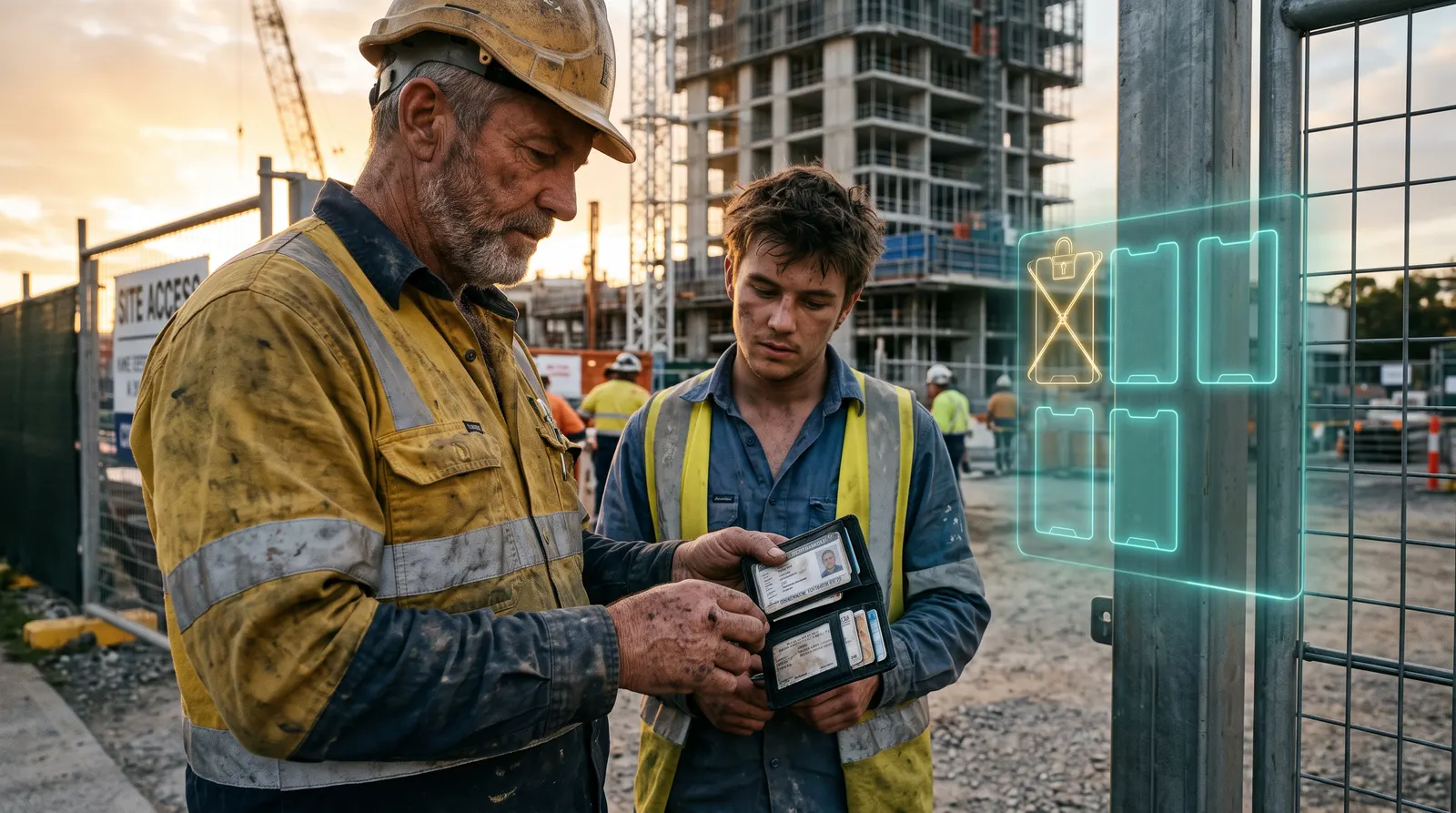
A ticket the agency doesn't know about does not exist.💡 If you hold something, get it recorded and send a photo of the card. If you are working towards one, say that too — it changes how an allocator thinks about you for the next few months.
2. Transport: what you can actually reach
Not compulsory. Genuinely important.
Most Sydney shifts start between 5am and 7am, which is before public transport is much help for a lot of the city. A worker with a car can be offered a job in an industrial estate at 6am. A worker without one cannot, no matter how good he is.
Plenty of good workers use public transport and get steady work. The map is just smaller, and the honest thing is to say which you are so nobody books you somewhere you cannot reach.
Transport is not about commitment. It is about which gates you can physically stand at before dawn.Say it plainly when you register: "own car, happy with 5am starts" or "public transport, best after 7". Both are useful. Vagueness is what costs you.
3. Communication: the part people underestimate
Not mandatory in any formal sense, and it changes everything.
An allocator has a short conversation with you and is trying to work out whether you understood the job. Not whether your English is perfect — plenty of our best workers are still building theirs. Whether you can:
This matters on site as much as on the phone. A worker who asks when he is unsure is safer and easier to have on a crew than one who nods and guesses.
4. Reliability: the whole game
Everything above is checkable. This one is judgement, and it is the one an allocator is really trying to read.
Because a client is paying for the day whether or not you arrive. A site short one bloke at 7am is a real problem for real people, and it is the thing an agency is trusted to prevent.
A skilled worker whose yes cannot be trusted is worth less than an ordinary worker who always turns up.The uncomfortable consequence, stated plainly: agencies give preference to workers who are both skilled and reliable. We want to give new people a start, and we do — but not on every job, and not on the ones where a failure would hurt a client badly.
That is not a judgement about you as a person. It is what happens when someone is trusted with somebody else's morning.
How reliability actually gets judged
Mostly from things that happen before you ever work a shift:
What this means if you are new
The honest version, without the encouragement-poster framing.
You are competing on the three things you can control, because you cannot yet compete on track record.
- Finish the paperwork in one sitting. This is the single biggest thing in your control and most people never complete it
- Be specific about availability. "Mon to Fri, nights fine, Saturdays fine" beats "I'm flexible" every time
- Take the awkward shifts. Nights, weekends, short notice. Fewer people put their hand up, so the queue is shorter
- Answer the first call. Not the second
Tickets get you into the pool. Transport decides which jobs you can reach. Communication gets you a real conversation. Reliability gets you booked again. Only the last one compounds, and it starts with the first shift you actually turn up to.
The bit worth repeating
🎯 Agencies are not looking for the strongest bloke on the deck. They are looking for someone a client will not ring them about.
Good nature, a pace you can hold, and a yes that holds. Brains and responsibility count as much as muscle.
Ready to get on the board? Register and finish your file the same day →
Related reads worth your time:
- 4 behaviours that get you re-booked every week in Sydney
- What the site says about you after you leave
- How to get your Sydney White Card this week
- Labourer jobs in Sydney: what is open right now
Frequently Asked Questions
What do labour hire agencies look for in a worker?+
Four things, roughly in order: current tickets for the role, a realistic way of getting to site, the ability to communicate clearly, and above all a read on reliability. The first three are checkable. The last one is judgement, and it decides most placements.
Do you need experience to get labour hire work in Sydney?+
It is not strictly mandatory, but it helps a great deal. Agencies give preference to workers who are skilled and reliable because a client is paying for the day either way. New workers do get a start, just not on every job.
Do you need your own transport for labour hire work?+
It is not compulsory but it widens the map enormously. Most Sydney shifts start between 5am and 7am, before public transport is much use, so a worker with a car can be offered jobs that others simply cannot reach in time.
Why is reliability more important than skill in labour hire?+
Because an allocator is answering one question: will this person be on that site in the morning. Skill only matters after someone turns up. A highly skilled worker whose yes cannot be trusted is worth less than an average one who always arrives.
How does an agency judge whether a worker is reliable?+
From how you behave before you ever work a shift. Whether you answer the phone, whether your paperwork arrives without chasing, whether you accept jobs you can genuinely do, and whether your answers stay clear and consistent.
Can a worker with no tickets get labour hire work?+
Not on a construction site. A current White Card (unit CPCCWHS1001) is a legal prerequisite, not a preference — without it no allocator can place you. Beyond that floor, skilled tickets such as a forklift licence (SafeWork NSW class LF), an EWPA Yellow Card for scissor lifts, Work Safely at Heights (RIIWHS204E) or a SafeWork NSW traffic control card widen what you can be offered and generally lift what you can earn.
What is the fastest way to get more labour hire shifts?+
Be easy to book. Answer quickly, give clear standing availability, keep your documents current, and only accept what you can finish. Those four do more than any additional ticket in the short term.