Sydney Wet-Weather Build Days: Roster Buffers That Save Margin (2026-27)
Sydney rain is predictable in aggregate and random by the day. How builders plan wet-weather days: the 10mm days that actually stop work, an inside-task pool, a fixed core plus flexible hire days, the call-off deadline, and what MA000020 clause 24 means for a host.
Sydney rain is predictable in aggregate and random by the day. Plan the aggregate, react to the day.
- The base rate: Sydney Observatory Hill averaged about 95 days a year with 1mm or more of rain, but only 32.5 days with 10mm or more (BoM records, 1991-2020)
- The award: MA000020 clause 24 sets when work stops, transfers to safe work, and pay for time lost
- The buffer: an inside-task pool, a fixed core crew, and flexible hire days for weather-exposed work
- The deadline: under Leap's 2026-27 terms, cancelling with under 12 hours' notice is charged 2 hours; under 1 hour, 4 hours
🌧️ 5:20am. Rain on the site shed roof. Eight labourers booked for 6, the slab prep half done, and the radar is a wall of green.
You can stand them down now and wear the cancellation. Or bring them in and hope it clears by 8.
Wet days don't wreck margins. Wet days nobody planned for do.How many rain days should a Sydney build plan for?
Roughly one day in four brings some rain. Over the most recent 30-year period, the Bureau of Meteorology's Sydney (Observatory Hill) record shows a mean of 94.8 days a year with at least 1mm of rain (BoM daily rainfall records, station 066062, 1991-2020).
The days that actually stop work are rarer. The same record averages 32.5 days a year with 10mm or more, roughly one day in eleven.
The months aren't equal.
| Month | Mean days of rain (1mm or more) | Mean days of rain (10mm or more) | Mean rainfall (mm) |
|---|---|---|---|
| January | 8.2 | 2.5 | 91.2 |
| February | 9.0 | 3.1 | 131.5 |
| March | 10.1 | 3.5 | 117.5 |
| April | 7.6 | 3.0 | 113.0 |
| May | 7.9 | 3.2 | 100.8 |
| June | 9.3 | 3.9 | 143.1 |
| July | 7.2 | 2.4 | 80.3 |
| August | 5.6 | 1.9 | 75.1 |
| September | 5.8 | 1.6 | 63.9 |
| October | 7.5 | 1.8 | 66.9 |
| November | 8.7 | 3.1 | 91.9 |
| December | 7.9 | 2.4 | 73.0 |
| Year | 94.8 | 32.5 | 1148.2 |
Source: calculated from Bureau of Meteorology daily rainfall records, Sydney (Observatory Hill) 066062, 1991-2020. The station closed in August 2020, and months with missing readings are left out. Over the full 1858-2020 record the averages are 99.5 rain days and 32.6 days of 10mm or more a year. These are averages, not a forecast.
Two honest caveats.
A rain day is not a lost day. A 1mm morning shower and a 60mm downpour count the same in the 1mm column. Plenty of those days are workable for most of the site.
Watch the 10mm column. In our experience, crews rarely get stood down for a shower. Jobs start getting called off when it's genuinely bad, and the 10mm count is the closer guide to those days.
On that measure, June (3.9) and March (3.5) are the worst months. May, February and November follow at about 3.1-3.2, and September (1.6) is the lightest.
November has got wetter. It averaged 3.1 days of 10mm or more in 1991-2020, against 2.4 over the full record. Further west it ranks higher still: at Parramatta North, February (3.4), March (3.1) and November (3.0) bring the most heavy days (BoM, 1991-2020).
Averages hide runs. A wet week in March can eat a pour sequence. The table tells you how much buffer to carry, not which day you'll need it.
You can't predict Tuesday. You can predict that February to June, plus November, will cost you more days than August or September.What does the award say happens to your crew when it rains?
MA000020 clause 24 governs inclement weather on general building and civil construction sites (cl.24.1, Fair Work, 2026). The parts a host needs to know:
- Definition (cl.24.2): rain or abnormal conditions (hail, extreme cold, high wind, severe dust, extreme heat) where it is not reasonable or unsafe to keep working
- Confer fast (cl.24.3): when employees ask, the employer must confer within a reasonable time not exceeding 60 minutes
- Record it (cl.24.4): the time work stops and resumes is recorded
- No forced work (cl.24.5): employees aren't required to start or continue where it's unreasonable or unsafe
- Pour exception (cl.24.5-24.6): a pour already started can be finished to a practical stage if there's no reasonable concern of imminent risk, paid at 200% of the ordinary hourly rate
- Time lost (cl.24.7): ordinary rate for ordinary hours when no work is possible anywhere, capped at 32 hours per 4 week period
- Dry areas keep working (cl.24.12) and employees can be transferred to safe work on the same site or another site, subject to work in their classification (cl.24.13)
- Remaining on site (cl.24.14): after set thresholds, such as an accumulated 4 hours of ordinary time lost in a day, employees can't be required to stay on site
What that means for a host using labour hire
The agency is the employer, so the award obligations run through it. What reaches you is the charge.
Two things to settle before the wet season, not on the morning:
- How rained-off time is charged for the crew you've booked. Ask your agency directly and get it in writing.
- Your minimum. Leap's 2026-27 terms carry a 4-hour minimum per shift, and the award gives casuals a 4-hour minimum per engagement (cl.12.3). A crew that arrives and is rained off at 7am is still a paid start.
What goes in an inside-task pool?
A written list of work that survives rain. Built on Friday for next week, not improvised at 6:15am.
Clause 24.13 lets you move people to safe work elsewhere, but only if that work exists and fits their classification. The pool is what makes the transfer clause worth anything.
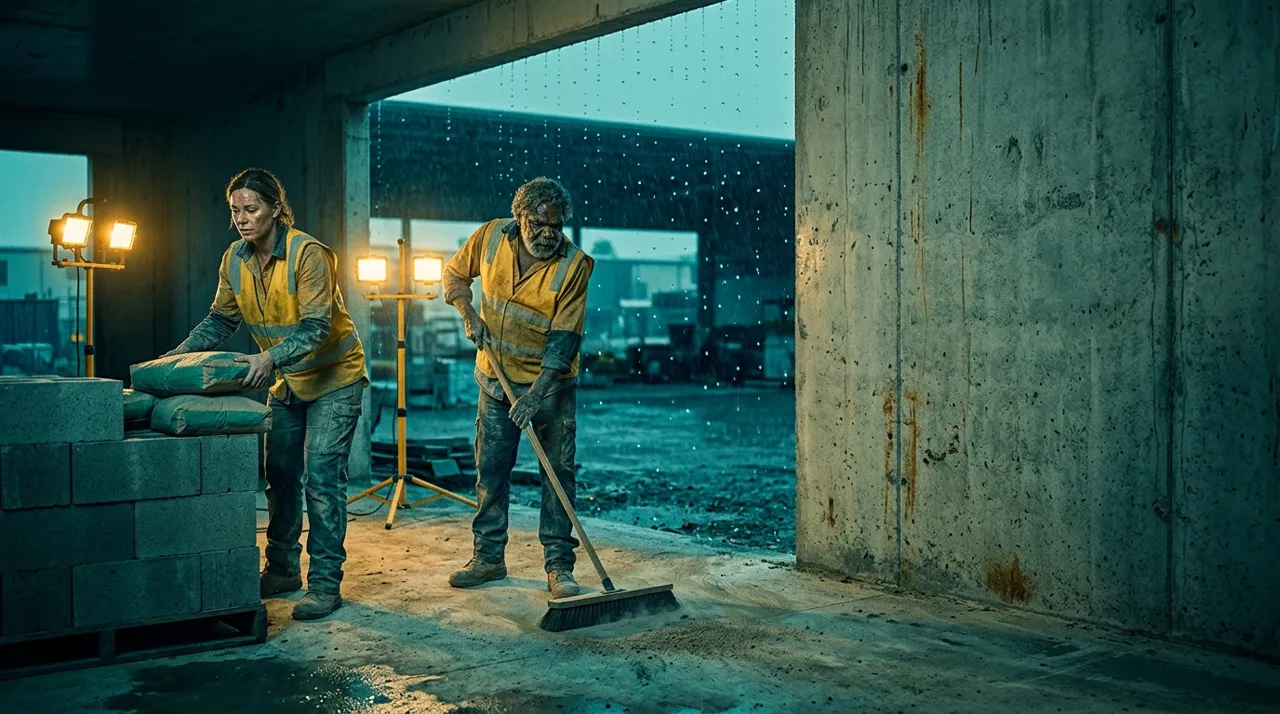
Keep it in the work order notes. If the agency knows your site has an inside pool, it can brief the crew that the shift may change, which beats a confused 6am handover.
Worth one line on every work order: "Wet weather: inside tasks available on levels 2-4."
Should you keep a fixed crew or book flexible hire days?
Both, split by what the rain can stop.
| Criteria | Fixed core crew | Flexible hire days |
|---|---|---|
| Use it for | Programme-critical work, inside and structural | Weather-exposed tasks: excavation, slab prep, external works |
| On a wet day | Moves to the inside pool | Not booked, or called off the afternoon before |
| Book it | Weeks ahead, ongoing | Once the forecast firms up, a day or two out |
| Main risk | Paying for a crew with nothing under cover to do | Booking too late for skilled or ticketed roles |
Highlighted cells = best option per criterion
The flexible half works because general labour moves fast. Leap's standard for labourers is same day or next day: a request in by early afternoon puts a worker on site the next morning. A standard, not a guarantee.
Skilled and ticketed roles are different. Don't plan to flex those day by day. Book them with real notice; how much notice labour hire actually needs covers why.
Why flexible hire suits the host on a wet day
Picture the 10mm morning with an all-direct-hire crew. Every one of them is your problem.
Under MA000020 cl.24.7, your own employees who can't work anywhere are paid for time lost, up to 32 hours in a 4 week period. Or they all pile onto the covered levels, and the dry areas get overcrowded with people the inside pool can't absorb.
More bodies under the same roof is not more work done.
Labour hire flexes down instead. The weather-exposed share simply isn't booked for that day, so the inside pool only has to carry your fixed core.
Rain flexes a labour hire crew down. Your own payroll doesn't flex.
When should you call it off, and how much notice does it take?
The afternoon before, wherever you can. That's where the cost sits.
Under Leap's 2026-27 Terms of Hire, cancelling with under 12 hours' notice is charged at 2 hours, and with under 1 hour's notice at 4 hours. For a 6am start, the 12-hour line falls at 6pm the night before.
Don't wait to see if it clears at 8. That's how a cheap call becomes a 4-hour one.
The 6pm phone call is the cheapest wet-weather insurance on the job.The short version
🎯 Sydney averages roughly 95 rain days a year. You don't know which ones. You do know they're coming.
Carry a written inside pool. Keep a fixed core for the critical path and flex the weather-exposed work. Make the call before 6pm, and settle how rained-off time is charged before the wet season starts.
Plan the aggregate, react to the day. Inside-task pool, fixed core plus flexible hire days, call-off by the afternoon before, and MA000020 clause 24 understood before the first wet Monday.
Want a crew that can flex with the forecast? Book casual labour hire in Sydney and tell us your wet-weather plan with the order.
For the full project view, read the complete guide to staffing a construction project in Sydney.
Frequently Asked Questions
How many rain days does Sydney get a year?+
Sydney Observatory Hill averaged about 95 days a year with at least 1mm of rain over 1991-2020 (Bureau of Meteorology records). Only about 32.5 of those days brought 10mm or more, from under 2 a month in August to October to 3.5 in March and nearly 4 in June, with February and November close behind at about 3. The heavier days are the ones that usually cost a build day.
What does the construction award say about working in the rain?+
MA000020 clause 24 covers inclement weather in general building and civil construction. Employees are not required to start or continue work where it is unreasonable or unsafe, and can be transferred to safe work elsewhere on the site or to another site, subject to alternative work in their classification.
Are workers paid when they are rained off?+
Under MA000020 clause 24.7, an employee who cannot work anywhere because of inclement weather is paid the ordinary rate for ordinary hours, capped at 32 hours in any 4 week period. For labour hire crews, the agency is the employer, so confirm with your agency how rained-off time is charged.
How late can you cancel a labour hire crew for rain?+
Under Leap's 2026-27 terms, cancelling with under 12 hours' notice is charged at 2 hours, and under 1 hour's notice at 4 hours. A decision the afternoon before a 6am start avoids both.
What work can a crew do on a wet day?+
Anything under cover that matches their classification and is safe: housekeeping on covered levels, moving materials into dry areas, cleaning and prep inside, and stacking or rubbish removal. Build that list before the rain, not on the morning.
Should a builder keep a fixed crew or use flexible hire days around weather?+
Usually both. Keep a small fixed core for programme-critical work, and book weather-exposed tasks as flexible labour hire days once the forecast firms up. On a heavy rain day the flexible days simply are not booked, so the site is not crowded with idle direct hires. Labourers can usually be supplied same day or next day as the standard.
Does a concrete pour have to stop when it rains?+
Not always. MA000020 clause 24.5 allows a pour already started to be completed to a practical stage, provided it does not create a reasonable concern of imminent risk to health or safety. That work is paid at 200% of the ordinary hourly rate (clause 24.6).