
Sydney Traffic Control Ticket 2026: Blue Card vs Yellow Card (and Which to Get First)
The bat ticket or the setup ticket? What each NSW traffic control card lets you do, the exact SafeWork units, the order to get them in, and what sites check on day one.
NSW traffic control runs on SafeWork NSW Traffic Control Work Training (TCWT) cards. Get the bat class first.
| "Blue card" | "Yellow card" | |
|---|---|---|
| SafeWork class | Traffic Controller (TCR) | Implement Traffic Control Plans (IMP) |
| What you do | Stop-slow bat, portable signals, signs | Set up the plan on the road |
| Covers the bat? | Yes | No |
Third class: Prepare a Work Zone TMP (PWZ), the designer ticket. Minimum age 17. Approved RTO only.
The return: a bat shift pays about the same as labouring (award CW2, one level above CW1). The upside is doing both jobs.
🚧 You turn up at 5:30am. The supervisor asks for your traffic control card. You hand over the wrong one.
That's a shift gone. No card for the class, no start, no pay.
So know the return before you book a course. On its own, a traffic control card pays about the same as labouring.
The real upside is being the worker who can do both: labour in the morning, hold the bat in the afternoon. That worker is a skilled labourer, and skilled labourers get paid more and booked more.
The "blue vs yellow" names you hear on site are shorthand. SafeWork NSW doesn't name its cards by colour. It names them by class, and each class lets you do one specific job.
Here's what each one covers, the order to get them in, and what gets checked before you're allowed near the road.
What are the traffic control tickets in NSW in 2026?
Three classes, one card, one issuer.
Since 1 July 2020, traffic control cards in NSW are issued by SafeWork NSW, not Roads and Maritime. You need one for any traffic control work on or adjacent to a public road.
SafeWork NSW lists three classes (2026):
| Criteria | Traffic Controller (TCR) | Implement TCP (IMP) | Prepare WZTMP (PWZ) |
|---|---|---|---|
| Site nickname | Blue card | Yellow card | Designer ticket |
| The job | Direct traffic to the plan | Set up the plan near the work | Design, vary or inspect the plan |
| Stop-slow bat | Yes | No | No |
| Set up a plan on the road | No | Yes | No |
| Usual first ticket | Yes | After the bat | Specialist path |
Highlighted cells = best option per criterion
It isn't only roadworks. SafeWork NSW gives the example of a supermarket loading dock off a public road, and a construction site where traffic has to stop for trucks in and out. Both need a carded worker.
The colour is site slang. The class on your card is what the supervisor actually checks.The nicknames come from the old RMS cards. If a job ad says "blue card", confirm it means the Traffic Controller class before you book a course.
Does a traffic control ticket pay more than labouring?
Not by much. That's the honest answer most course ads skip.
Under the Fair Work Building and Construction General On-site Award (MA000020), "traffic controller" is listed as an indicative task at Level 2 (CW/ECW 2). A qualified general labourer sits at CW/ECW 1, one level down.
At award minimums from 1 July 2026, the gap between CW2 and the top CW1 level is about 2%. In practice, a bat-only shift pays about the same as a labouring shift.
The ticket on its own isn't a pay rise. Being able to do both jobs is.The real return is range. A labourer who also holds a TCWT card can be booked for the labouring job, the traffic job, or both on the same site.
That makes you a skilled labourer. Skilled labourers are paid on a higher tier than general labourers, and they tend to get more shifts because they fit more bookings.
Some traffic control companies pay under their own enterprise agreement instead of the award. Check your payslip against whichever one applies. For the take-home maths, see the Sydney labourer's pay guide.
What's in the blue card course (Traffic Controller)?
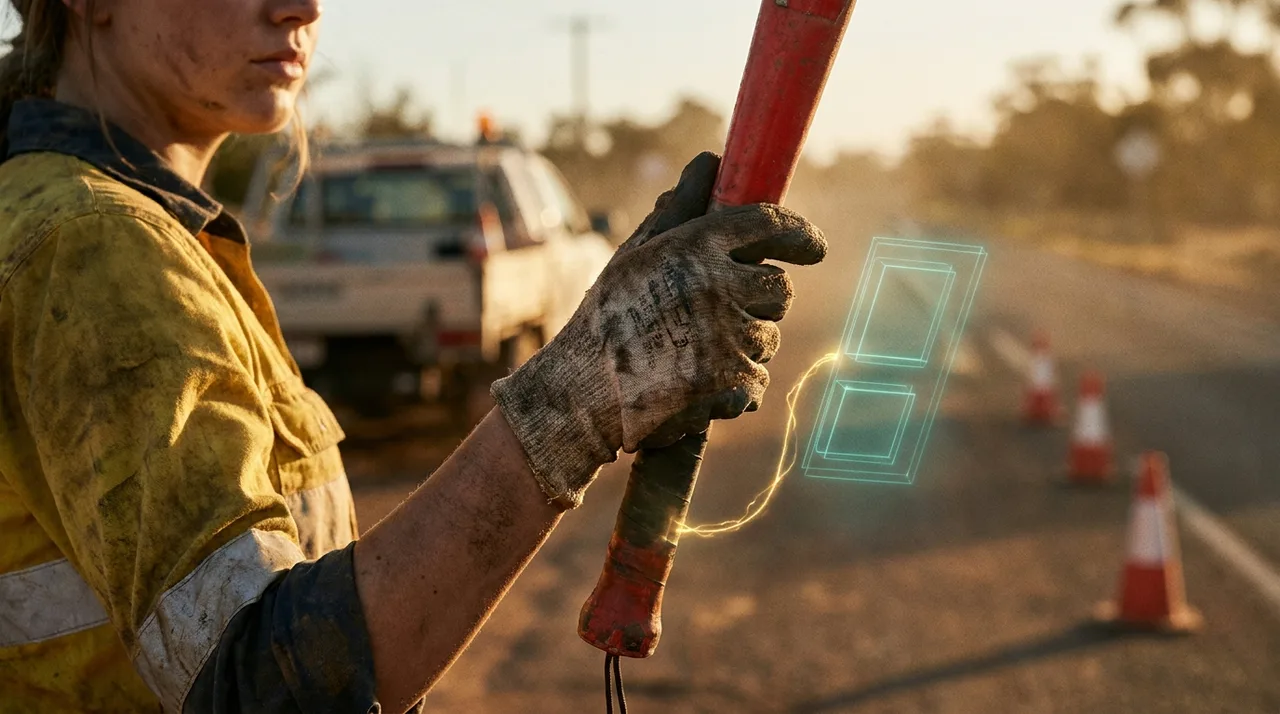
It's the entry point. SafeWork NSW describes it as a good entry point into traffic control.
The approved course covers four units (training.gov.au codes, current in 2026):
- RIIWHS201E Work safely and follow WHS policies and work procedures
- RIICOM201E Communicate in the workplace
- RIIWHS205E Control traffic with a stop-slow bat
- RIIWHS206 Control traffic with portable traffic control devices and temporary traffic signs
That covers stopping and starting traffic with a bat or boom gate, and working portable signals and signs.
What it doesn't cover: setting up or working with traffic control plans. You work to a plan someone else implemented.
What's in the yellow card course (Implement Traffic Control Plans)?
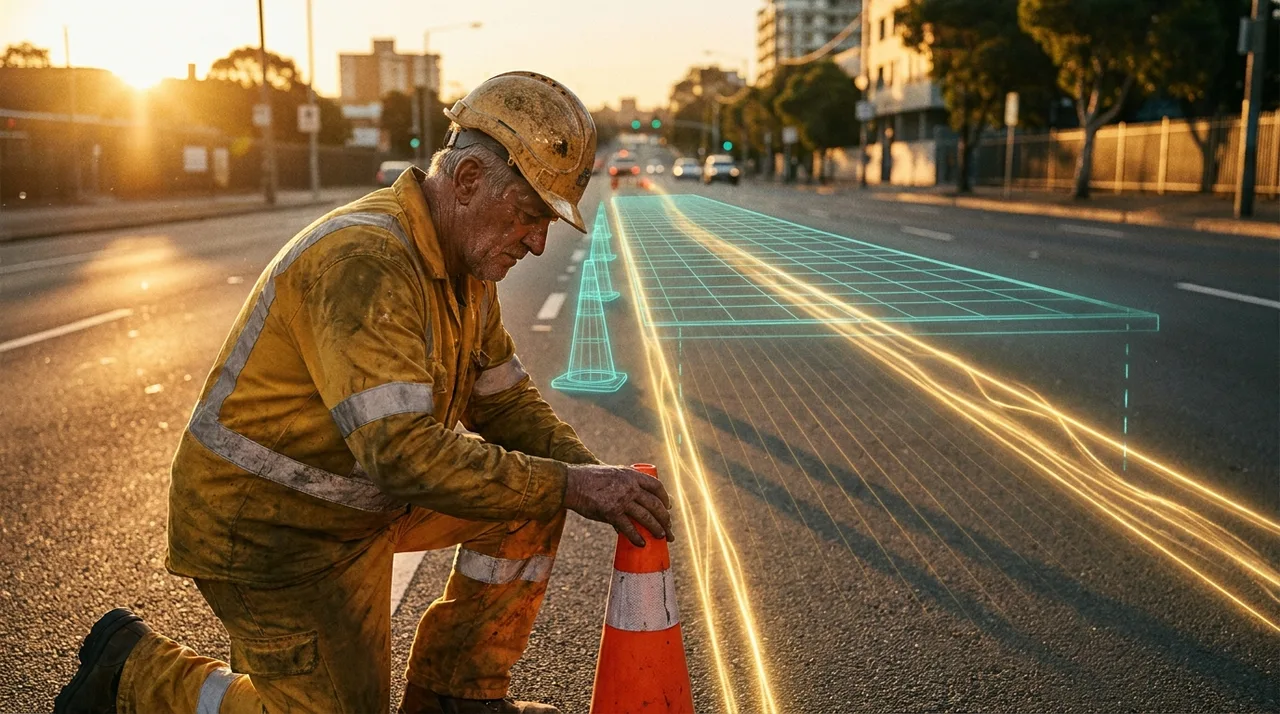
This is the setup ticket. You take the plan and put it on the road: cones, signs, tapers, the lot, in the immediate vicinity of the work.
The approved course covers five units:
- RIIWHS201E Work safely and follow WHS policies and procedures
- RIICOM201E Communicate in the workplace
- RIIRIS301 Apply risk management processes
- RIIWHS302 Implement traffic management plans
- RIIWHS303 Position, set-up and program portable traffic control devices
The older "E" versions (RIIRIS301E, RIIWHS302E) stay approved until 1 September 2027. A course still using them is fine until then.
Here's the bit most people miss. SafeWork NSW says the IMP course does not qualify you to use a stop-slow bat, and doesn't let you modify an existing plan.
The yellow card doesn't include the bat. If you want to set up the job and stand on it, you need both classes.On TfNSW-delivered works, setups follow the Traffic control at work sites Technical Manual. The IMP holder is the one applying it on the ground.
How do you get a traffic control card, step by step?
Six steps. None of them can be skipped.
On cost: course prices vary between providers. Ask each one what's included (assessment, card application help, re-sits) before you book.
You can check providers through Service NSW's traffic control training course check. For the White Card itself, see how to get your Sydney White Card this week.
Should you get the blue card and yellow card at the same time?
Usually not. Bat first, setup second.
The bat class gets you working. The setup class is more useful once you've seen how real closures run, from the bat end.
A fresh IMP holder who has never stood on a closure is a harder sell to a supervisor than a bat hand with site time behind them. Courses train you. Site time is what gets you trusted with the setup.
Get on the bat, learn how real closures run, then add the setup class. That's the path that wastes the least.Where traffic control sits against other tickets you might stack (forklift, EWP, dogging) is covered in our construction tickets ROI ranking. We won't repeat it here.
Can you use an interstate traffic control card in Sydney?
Often yes, with conditions.
Traffic control is in the Automatic Mutual Recognition (AMR) scheme. Licensed workers from other states can work in NSW without a second licence, except Queensland (SafeWork NSW, 2026).
Three conditions:
- The licence must be issued by a government licensing regulator. NSW does not accept Victorian training issued only by an RTO.
- Your home-state licence must be current.
- You must notify SafeWork NSW before you work here.
Moving from Queensland? Plan on doing NSW training.
What do Sydney sites check before you start?
Three things, usually in this order.
- Photo ID that matches the name on your cards.
- White Card.
- Your TCWT card, with the right class for the job you've been booked for.
Supervisors can verify a card on Verify NSW.
⚠️ Keep a photo of both cards on your phone as a backup, and the physical cards in your hi-vis.
Where does the traffic control work come from?
Roadworks, civil, council jobs, utilities, and construction sites with truck movements on a public road. A lot of it runs on nights and weekends, where award penalty rates apply.
Two things to protect yourself on pay:
- Get a payslip for every pay period, with 12% super on top (from 1 July 2025).
- Sign your timesheet at the end of every shift and keep a copy.
Cash weekend bat work still gets offered. Skip it: no workers comp if a vehicle clips you, and no payslip for a visa or a loan. We cover why in the real cost of cash-in-hand work.
💡 Leap is a labour hire company, not an RTO. We don't sell courses. We place carded traffic controllers on Sydney sites. Traffic-control-only roles take longer to match than general labour. Labourers who can also run the bat are the ones we can book most often.
Got your card and want work? Register with Leap or browse labourer jobs in Sydney. Builders hiring controllers should read traffic controller hire in Sydney instead.
Frequently Asked Questions
What's the difference between a blue card and a yellow card in NSW traffic control?+
On site, 'blue card' usually means the Traffic Controller class (stop-slow bat and portable devices) and 'yellow card' means Implement Traffic Control Plans (setting up the plan on the road). SafeWork NSW names its cards by class, not colour.
Who issues traffic control cards in NSW in 2026?+
SafeWork NSW. It has issued Traffic Control Work Training (TCWT) cards since 1 July 2020, when the job moved from Roads and Maritime Services. Training and assessment must be done with a SafeWork NSW approved training provider.
Does the yellow card let me work the stop-slow bat?+
No. SafeWork NSW states the Implement Traffic Control Plans course does not qualify you to control traffic with a stop-slow bat or boom gate. Lead hands who do both need both classes on their card.
Which traffic control ticket should I get first?+
The Traffic Controller class (the blue card). It is the SafeWork NSW entry point, it gets you on the bat, and site time on the bat makes the Implement Traffic Control Plans class far easier to use when you add it.
Does a traffic control ticket pay more than labouring?+
Not by much on its own. The Fair Work Building and Construction General On-site Award (MA000020) lists traffic controller at Level 2 (CW/ECW 2), one level above a qualified CW1 labourer, a gap of about 2% at minimum rates from 1 July 2026. The bigger return comes from being a skilled labourer who can do both labouring and traffic control.
Can I work under supervision before my card arrives?+
Yes, in one case. SafeWork NSW says students who have completed training and hold a valid Statement of Completion can carry out supervised work until they complete their final assessment.
Can I use an interstate traffic control card in Sydney?+
Usually, under Automatic Mutual Recognition, if it was issued by a government licensing regulator and you notify SafeWork NSW. Queensland is excluded, and NSW does not accept Victorian training issued only by an RTO.
How old do I need to be to get a traffic control card in NSW?+
At least 17, and you must have completed training and been assessed as competent in the relevant class with a SafeWork NSW authorised registered training organisation.