
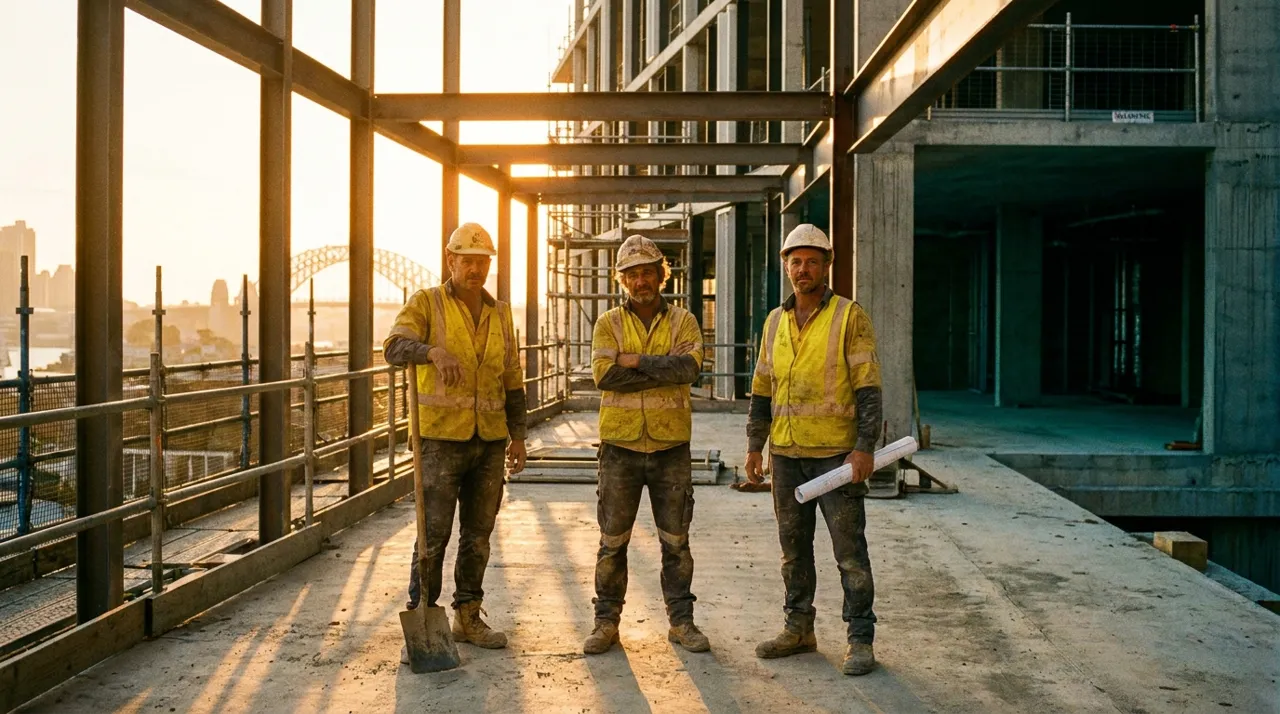
Subcontractor vs Labour Hire in Construction
Subcontractor vs labour hire in Sydney construction 2026 — the legal split, real costs, sham contracting risk, Same Job Same Pay, and which one fits your job.
A subcontractor owns the deliverable and runs their own business; a labour hire worker is employed by the agency and directed by you on site — get the classification wrong and you're exposed to $495k sham contracting penalties.
| Subcontractor | Labour hire | |
|---|---|---|
| Employer | Their own ABN/business | Labour hire agency |
| Who supervises | Subbie controls their work | You direct on site |
| WHS liability | Subbie carries for their scope | Shared: you (site) + agency (comp) |
| Workers comp | Subbie's own policy | Agency's iCare policy |
| Use when | Buying a deliverable/outcome | Buying supervised hours |
Misclassifying an employee as a subcontractor = sham contracting; penalties up to $495,000 per breach from August 2024.
Get the subcontractor vs labour hire classification wrong and you're exposed to $495,000 sham contracting penalties, criminal wage theft charges, and a SafeWork NSW inspector in your site shed asking who supervised the worker on the scaffold. ⚠️
This is the call every Sydney builder makes — hours, or outcomes. Bodies, or a finished slab.This guide is for builders, site managers, and project coordinators who already know the words subcontractor and labour hire but want to know exactly where the line sits in 2026 — legally, financially, operationally. 🏗️
Table of Contents
- The Legal Split: Two Different Animals
- How the Contracts Work
- Who Pays What — The Real Cost Comparison
- Sham Contracting: The $495K Trap
- Same Job Same Pay and Closing Loopholes
- WHS Duty of Care: Joint Liability
- When Subcontractors Win the Job
- When Labour Hire Wins the Job
- The Hybrid Model
- NSW Compliance Checklist for 2026
- Payroll Tax, Super, Long Service
- Decision Framework
- Cash Workers — A Note
- FAQ
The Legal Split: Two Different Animals
A subcontractor and a labour hire worker look the same in the smoko shed. Same hi-vis, same boots, same coffee. The difference is in the paperwork — and the paperwork is what the Fair Work Ombudsman pulls when something goes wrong.
A subcontractor is engaged under a contract for services. Their business — sole trader, partnership, or company — is engaged by yours to deliver a defined scope.
They invoice you. They quote a price. They carry their own insurance.
Labour hire is a tripartite arrangement. The labour hire firm employs the worker, pays the worker, and supplies the worker to you to perform work under your direction.
You pay the agency, not the worker. The agency owns the employment relationship — leave, super, PAYG, workers comp.
The legal test isn't what you call the arrangement — it's how it actually works. Calling someone a "subcontractor" on the invoice does not make them one if you set their hours, supervise them daily, supply their tools, and pay them by the hour. That's the path straight to sham contracting territory.
The Fair Work Ombudsman uses a multi-factor test. No single factor wins:
- Control — who decides when, where, how the work is done?
- Mode of payment — fixed sum for a deliverable, or hourly for time spent?
- Tools and equipment — who supplies the gear?
- Delegation — can the worker send someone else?
- Risk — who wears the cost of bad work or delays?
- Integration — is the worker part of your business, or their own?
The High Court's 2022 decisions in CFMMEU v Personnel Contracting and ZG Operations v Jamsek shifted the analysis back onto the written terms of the contract — but only where the contract is genuine and comprehensive. If the contract says "contractor" but the day-to-day relationship looks like employment, courts still rip the label off.
NSW does not yet have a labour hire licensing scheme. The Labour Hire Licensing Bill 2017 lapsed. The NSW Government is working with the Commonwealth and other states on a nationally consistent framework — but as of 2026 there is no state register or licence number. Three things still apply: Fair Work Act protections for workers, WHS Act primary duty on the host, and the contractor provisions in the Payroll Tax Act.
How the Contracts Work
The subcontract carries
- Scope of work — what specifically gets built or done
- Price — fixed sum, schedule of rates, or cost-plus
- Program — start date, milestones, completion, LDs for delay
- Variations clause — how changes get priced
- Defects liability period — usually 12 months in NSW
- Insurances — public liability ($10M is the normal level), workers comp, PI if design involved
- Security of payment — Building and Construction Industry Security of Payment Act 1999 (NSW) applies
A subbie carries productivity risk. Quote $48,000 to form a slab, take three weeks instead of two, they wear the loss.
The labour hire agreement carries
- Hourly charge-out rate — including margin, super, payroll tax, workers comp, leave loading
- Trade categories supplied
- Notice period — usually 24 hours to cancel a confirmed shift without charge
- Minimum engagement — typically 4 hours per worker per day
- Right to direct — the host supervises; agency supplies replacement if worker underperforms
- Indemnity — agency indemnifies host for wage/super claims; host indemnifies agency for site safety incidents inside the host's control
No productivity risk for the agency. You buy hours. If the hours turn into a slab, great. If they don't, you still pay the hours.
Subcontracts usually attract SOPA. Labour hire usually doesn't (no defined deliverable). Matters if the head contractor goes broke mid-job.
Who Pays What — The Real Cost Comparison
The hourly rate is not the cost. Here's what actually loads onto a worker hour in Sydney 2026.
Direct hire — true loaded cost
Under MA000020, a CW1 general labourer (Level 1, 12+ months experience) sits around $27/hr ordinary time from 1 July 2025. Load it up:
Illustrative example only — not Leap's pricing. Loaded costs vary by worker, site, and EBA status.
That's before PPE, induction, white card verification, or the cost of a worker who doesn't show up for week two.
Subcontractor pricing
A subbie quote bundles labour, materials, program risk, and margin. For a defined scope, the comparable is a deliverable price (e.g. $/m² for formwork), not an hourly rate. Apples to oranges.
Labour hire charge-out — what drives it
A labour hire charge-out is a single all-in $/hr per classification. It is not the bare award rate. It is the loaded employment cost plus the agency's margin for carrying the payroll, the insurance, and the supply risk.
What moves the number, in plain terms:
- Classification — a general hand sits below a skilled labourer, which sits below a ticketed specialist.
- Day type — standard, nightshift, OT1, OT2, public holiday each step the rate up.
- Tickets and risk — HRWL work, welding with own tools, and specialist trades price higher.
- Engagement mode — on-hire versus subcontract changes the pricing and tax treatment.
The illusion that labour hire is "expensive" comes from comparing the charge-out to the bare award rate.
The honest comparison is charge-out versus the true loaded cost of a direct hire — plus your own time recruiting and managing them.A quote that lands materially below the market is usually underpaying workers (your sham contracting risk) or running at structural loss (your continuity risk). Either way, ask the agency to confirm in writing that the worker is paid per Fair Work or the site EBA.
For short-term, variable-demand work, labour hire wins on total cost.
For permanent crew on long programs, direct hire wins. The break-even sits around 12 weeks of continuous engagement for most Sydney builders.
Sham Contracting: The $495K Trap
Sham contracting is when an employer tells a worker they're a contractor when the law says they're really an employee. Illegal under section 357 of the Fair Work Act 2009. After the Closing Loopholes amendments that came into effect through 2024-2025, the rules tightened hard.
The test is now reasonableness. Before 26 August 2024, an employer could defend by showing they didn't recklessly misrepresent the relationship.
From 26 August 2024, you have to show you reasonably believed the worker was a genuine contractor at the time. "Reckless" is "I didn't think about it." "Reasonable" is "I thought about it and here's what I concluded."
Then the penalties. For businesses with 15+ employees, the maximum per contravention is the greater of $495,000 or three times the underpayment amount.
Add back-pay of every entitlement the worker should have received as an employee — leave, super, public holidays, redundancy — and project margin disappears.
Fair Work Ombudsman recently secured nearly $200,000 in penalties against a Sydney company that terminated workers' employment to re-engage them as contractors. FWO has live investigations in building and construction and road transport.
How builders get caught
- Paying long-term labourers on ABN at hourly rates with no defined scope
- Requiring "contractors" to wear company hi-vis and use company tools
- Setting fixed daily hours and rostering them like employees
- Telling new workers to "go get an ABN by Monday" before starting
- Treating the same person as a subbie for 18 months on rolling daily engagements
- Using "labour hire" agencies that are really just payroll cutouts for direct hires
Here's the labour hire safety valve. When you engage workers through a legitimate agency, the agency carries the employment relationship.
You can direct, supervise, and set the worker's hours without converting them into your employees.
That's the commercial purpose of labour hire — the flexibility of contracting without the sham contracting risk.Same Job Same Pay and Closing Loopholes
The Closing Loopholes legislation introduced the biggest shift in Australian labour hire law in two decades — the regulated labour hire arrangement order (commonly called Same Job Same Pay). It started taking effect from 1 November 2024 and rolls out progressively.
What it does: if your project is covered by an enterprise agreement (EBA) that sets pay rates above award, labour hire workers performing the same work as your direct employees can apply to the Fair Work Commission for an order requiring the agency to pay them no less than the EBA rate.
In practice, this hits EBA-pattern construction sites hardest. A site EBA might set a CW1 labourer rate at $48/hr. Under a SJSP order, the agency must pay the worker at that rate — and the charge-out lifts accordingly.
Carve-outs apply: short-term arrangements (less than 3 months), training arrangements, small business hosts (fewer than 15 employees). The worker has to actually apply for the order; it doesn't apply automatically.
Then there's the criminal wage theft law. From 1 January 2025, intentional underpayment of wages or entitlements is a criminal offence.
Individuals face up to 10 years' imprisonment. Companies face fines up to $8.25 million or three times the underpaid amount, whichever is greater. Sits on top of, not instead of, civil penalties.
The era of "we'll sort the paperwork later" is over. Sort it before the work starts, or don't start the work.
WHS Duty of Care: Joint Liability
Labour hire does not transfer your safety duty.Under the WHS Act 2011 (NSW), both the agency and the host hold a primary duty of care to the worker. SafeWork NSW investigates both parties when something goes wrong.
As host, you must
- Pre-engagement risk assessment — identify hazards specific to the work
- Site induction — labour hire workers get the same induction as direct hires
- Consultation — consult the agency on duties, location, equipment, hazards, PPE before changing tasks
- Supervision — same standard as direct hires
- Incident reporting — notify SafeWork for notifiable incidents
- SWMS coverage — labour hire workers must be covered by the relevant Safe Work Method Statement
As the agency, we must
- Verify the worker's competency — tickets, licences, White Card, prior experience
- Consult on the workplace — visit the site or get written hazard info before placing the worker
- Provide workers compensation — agency carries the policy
- Replace underperformers — supply a competent replacement when the host requests one
For the full incident-reporting playbook, see SafeWork NSW notifiable incidents and host employer responsibilities.
| Criteria | Option A | Option B | Option C |
|---|
Highlighted cells = best option per criterion
When Subcontractors Win the Job
- Defined scope, fixed price — "form, place, and finish 320m² of suspended slab to drawing SS-04 by 14 June" is a subcontract job. Subbie wears the productivity risk.
- Specialist trades you can't supervise — waterproofing, post-tensioning, glazing, façade, lifts, structural steel.
- Long-program, high-volume work — 6+ months of the same activity, continuity wins.
- Plant-heavy work — earthmoving, mobile cranes, demolition. Subbie owns and operates the gear.
- Off-site fabrication — trusses, precast, prefab. Can't labour-hire a panel.

When Labour Hire Wins the Job
- Surge demand — contract starts in 10 days, no crew. Same-day named confirmation before 10am is the standard for general labour, formworkers, dogmen, traffic controllers.
- Variable workload — labour curve isn't flat. Scale up and down by ringing one number.
- Coverage for absentees — labour hire is the only mechanism that delivers next-morning coverage at scale.
- Trial-to-hire — legal way to do a 4-week trial without committing.
- Compliance burden you don't want — a 6-week pour-and-finish doesn't justify direct hire admin.
- Specialist tickets on short engagements — forklift for a 3-day pallet move, EWP operator for a one-week strike.
The Hybrid Model
Most Sydney sites run both. A common 2026 Sydney commercial build:
- Subcontractors — formwork, post-tensioning, structural steel, façade, lifts, fitout joinery, waterproofing, glazing
- Labour hire — general labourers, dogmen, traffic controllers, leading hand carpenters supporting form crew, demo labour, warehouse pickers
- Direct hires — site manager, project coordinator, foreman, OHS officer, contracts admin
Biggest operational risk on a hybrid site is unclear supervision. Fix it in induction. Every labour hire worker gets told, in writing and verbally: who their site supervisor is (named), which subbies they're working alongside not for, who they call for safety problems (host site supervisor first), who they ring if they can't make it in tomorrow (the agency).
NSW Compliance Checklist for 2026
Payroll Tax, Super, Long Service
Three statutory schemes catch out Sydney builders. Get them right at the start; get them wrong and Revenue NSW assesses six years later with penalties.
Payroll tax is the contractor provisions trap. NSW payroll tax is 5.45% in 2026 on wages above the $1.2M annual threshold.
The contractor provisions in the Payroll Tax Act 2007 (NSW) can deem payments to labour hire firms (and to "labour-only" subbies) as taxable wages of the host.
Common exemptions: services less than 90 days a year, services ancillary to goods, services to the general public, approved owner-drivers. They're narrower than most builders realise — get specialist advice.
On superannuation, SG sits at 12% from 1 July 2025. For contractors paid wholly or principally for their labour, the SG provisions deem the principal liable for super on the labour component.
A subbie running a real business with their own materials and a fixed quote is usually outside this. A "subbie" paid by the hour with the foreman pointing at the work is usually inside it.
Then there's Long Service Corporation NSW. Every construction worker in NSW — direct hire, labour hire, subcontractor, working directors — accrues entitlements under the Building and Construction Industry Long Service Payments Act 1986.
Builders must register, report worker days each return period, and pay the levy on construction costs above the threshold. Every day a labour hire worker is on your site, the day belongs to the LSC return.
Decision Framework
For most Sydney commercial builds the answer is both. Subcontractor scopes for specialist deliverables, labour hire for variable on-tools demand, direct hire for the management spine.
For deeper reading: labour hire cost breakdown, compliant labour hire Sydney, labour hire vs recruitment agency, is labour hire worth it.
Cash Workers — A Note
If anyone on your site is being paid cash, your exposure goes up, not down. A cash worker is still a worker under the WHS Act — your section 19 duty applies.
They almost certainly have no workers comp coverage, so an injury lands on the host PCBU directly. Sham contracting penalties run up to $93,900 per breach for companies (Fair Work, 2025). The ATO and SafeWork NSW run joint enforcement on cash construction work.
The simplest control: every worker on site is on a PAYG payroll — yours, a subbie's, or a labour hire agency's.Honest Note: Yes, Leap Is a Labour Hire Company
Leap Labour is a labour hire company. We supply general construction labour, formworkers, traffic controllers, dogmen, leading hands, warehouse pickers, and forklift operators to Sydney builders and warehouses.
We have a horse in this race. If you read this guide and decide labour hire is the right tool for your next job, we'd like that to be a call to our number. If you read it and decide a subcontractor is the right tool — that's fine too. We're not the answer for a post-tensioning scope or a façade install. We're the answer for bodies on the tools by tomorrow morning.
Our pitch isn't cheapest charge-out. It's named crew confirmed same-day before 10am and a single all-in $/hr per classification with day-type rates (standard / nightshift / OT1 / OT2 / PH) and Fair Work compliance confirmed in writing on request. If a competitor is quoting materially below the market range, they're not running a sustainable agency. Use them once, watch what happens.
Get Crew or Get a Quote
Need bodies on the tools tomorrow? Get a quote in your inbox →
Got a job starting next week and not sure what mix of subbies and labour hire fits? Run rates through our check-rates tool →.
If you're a worker reading this and wondering how labour hire engagements work from the inside, find work with Leap →.
Frequently Asked Questions
What is the legal difference between a subcontractor and labour hire in NSW construction?+
A subcontractor is engaged by your business under a contract for a defined scope of work and runs their own operation — they invoice you, carry their own insurance, and own the deliverable. Labour hire is a tripartite arrangement: the labour hire firm employs the worker, pays them, and supplies them to your site under your direction. You contract with the agency, not the worker. Subbies own the deliverable. Labour hire owns the hours.
Can a builder be liable for sham contracting if a subcontractor turns out to be misclassified?+
Yes. Under the Fair Work Act after the Closing Loopholes changes that started 26 August 2024, the defence shifted from a 'recklessness' test to a 'reasonableness' test. To defend a claim, an employer must prove that at the time the representation was made, they reasonably believed the worker was engaged as a contractor. Penalties for businesses with 15+ employees reach the greater of $495,000 per contravention or three times the underpayment amount, plus back-pay of all employee entitlements.
Does NSW require a labour hire licence in 2026?+
No. NSW has no labour hire licensing scheme as of 2026. The NSW Government is working with the Commonwealth and other states on a nationally consistent framework. Other states — Queensland, Victoria, South Australia, ACT — do have licensing schemes. In NSW, host obligations under the WHS Act 2011 still apply, and federal Fair Work Act protections cover the workers.
What does Same Job Same Pay mean for builders using labour hire?+
Under the Fair Work Act amendments rolled out through Closing Loopholes, eligible labour hire employees can apply to the Fair Work Commission for a 'regulated labour hire arrangement order' that lifts their pay to no less than the rate they would receive under the host's enterprise agreement. On EBA sites this changes labour hire pricing — the agency must pay the worker at the EBA rate, and the charge-out lifts accordingly.
Is labour hire cheaper or more expensive than subcontractors for short Sydney jobs?+
For pure on-tools labour under 8 weeks of variable demand, labour hire is usually cheaper once you account for the loaded cost of direct hire (super, payroll tax, workers comp, leave accruals, recruitment, onboarding). For defined-scope work — fitout, formwork, demolition — a fixed-price subcontract often comes in lower because the subcontractor carries productivity risk. The choice depends on whether you're buying hours or a deliverable.
What happens if a labour hire worker is injured on my site?+
Both the labour hire agency and the host carry a duty of care under the WHS Act 2011 (NSW). The workers compensation claim runs through the agency's policy. But SafeWork NSW still investigates the host for the safety conditions on site. If your induction was inadequate, supervision loose, or the SWMS didn't cover the activity, you remain liable for the safety breach even though the agency carries the workers comp.
Can a subcontractor work alongside labour hire crew on the same site?+
Yes — most Sydney commercial sites run both. The subcontractor's crew remains under the subcontract company's direction for their scope. Labour hire workers take direction from your site supervisor. Document the chain of command in the site induction and SWMS. Both groups should be in your toolbox talks and emergency procedures — supervisory line stays separate.
What's the ATO test for distinguishing an employee from a genuine subcontractor?+
The ATO uses a multi-factor test looking at the whole working arrangement — ability to subcontract or delegate, basis of payment (hourly vs deliverable), who provides tools and equipment, commercial risk borne by the worker, control over how the work is performed, independence of the operation. The High Court's 2022 decisions in CFMMEU v Personnel Contracting and ZG Operations v Jamsek confirmed that written contract terms matter more than informal day-to-day behaviour — but only where the contract is genuine and comprehensive.
Are wage theft penalties criminal now in Australia?+
Yes. From 1 January 2025, intentional underpayment of wages or entitlements became a criminal offence under the Fair Work Act. Individuals face up to 10 years' imprisonment. Companies face fines up to $8.25 million or three times the underpaid amount, whichever is greater. The serious contravention threshold also dropped from 'knowing and systematic' to 'knowing or reckless'.
How fast can a labour hire agency get crew on a Sydney site?+
Decent agencies confirm worker names by close of business for next-morning starts inside Sydney metro. Less than 24 hours is the standard for general construction labour, formworkers, dogmen, traffic controllers. Specialist tickets — leading hand carpenters, signalman cranes, EWP-licensed operators — usually need 48 hours' notice depending on the size of the agency's worker pool.
External references:
- Fair Work Ombudsman — Independent contractor changes (Closing Loopholes)
- Fair Work Ombudsman — Sham contracting
- Fair Work Ombudsman — Labour hire and supply chains
- SafeWork NSW — Contractors and labour hire
- NSW Government — Update on Labour Hire Regulation
- Fair Work Ombudsman — Criminalising wage underpayments