
Starting Construction in Sydney When Your English Is Not Good Yet: The Complete Guide (2026)
How to start on a Sydney construction site when your English is weak: the trade words school never taught you, a starter vocabulary you can screenshot, how to use AI translation properly, and what to say on site.
To start on a Sydney site when your English is weak:
- Learn the words of your trade first, not general English. Tools, materials, measurements, directions
- Learn the safety calls before anything else, because those are the words where not understanding hurts you
- Keep a translation app in your pocket, with camera mode for labels and signs, and voice mode for a slow two way chat
- Say "show me once" instead of nodding, then repeat the instruction back in your own words
- Never pretend you understood a safety instruction. Ask a human, twice if you need to
Under the model WHS Regulations, safety information must be given in a way you can understand. That duty sits with the business, not with you.
Here is the thing nobody tells you before your first shift.
You can pass an English test, watch films without subtitles, hold a conversation in a cafe, and still stand on a slab in Marrickville with no idea what the bloke just asked you to bring him.
Because he did not use school words. He said "grab us the stringline and a couple of star pickets."
The English you need on a site is not the English school teaches. School gives you grammar. A site runs on tool names, and nobody teaches those.That gap is the whole problem. It is also completely fixable, and faster than you think, because the list of words you actually need is short.
Here is how to build that list, how to use AI properly as your translator, and what to say on site while your English catches up.
Table of Contents
- Why is site English so different from school English?
- How do you study the words of your own trade?
- Which words should be on your first list?
- Which safety words must you understand instantly?
- How do you use AI as a translator on site?
- What do you say on site while your English catches up?
- What about site inductions and toolbox talks?
- What does WHS law say about instructions you did not understand (2026)?
- Frequently Asked Questions
Why is site English so different from school English?
Because they were built for two different jobs.
A classroom teaches you to describe, explain and be polite. Tenses, articles, small talk, the weather. All useful in a cafe.
A site does something else. It moves heavy things safely, in noise, fast. So site language is short, physical and specific.
Nouns, not sentences. Half the instructions you get on a site are one object and one direction. "Stringline. Over there."
Slang instead of the dictionary word. A wheelbarrow is a barrow. A carpenter is a chippy. An excavator is a digger or the machine's size, like a five tonner. Morning tea is smoko.
Australian words, not American ones. Your app may have taught you a flashlight. On site it is a torch. A truck bed is a tray. A crew is a gang.
Sound with no words at all. A whistle, a hand up, two taps on a beam. That is language too, and you learn it by watching.
Nobody on a site is testing your grammar. They are testing whether the right thing arrived, in the right place, safely.This is good news. It means your target is much smaller than "learn English". Your target is "learn maybe two hundred words that my trade uses every day".
That is a few weeks of deliberate work, not a few years.
How do you study the words of your own trade?
Not by studying English. By studying your trade, in English.
The mistake almost everyone makes is opening a general English app and grinding through lessons about ordering coffee. Nine months later you still do not know what a stringline is.
Here is the method that works, and it takes fifteen minutes a day.
Three rules make this stick.
Learn the object, not the translation. If you learn "acero equals steel", you translate every time you hear it, and translation is slow. If you learn the picture of the bar with the word steel on it, you skip a step. Speed matters when someone is waiting.
Learn it in the phrase you will hear. Not "hammer". Learn "pass us the hammer", "grab the hammer", "where's the hammer". Same word, three shapes, and the shape is most of the difficulty.
Ask for the Australian word specifically. This one costs people weeks. Ask a workmate: "What do you call this one here?" Then write down what he actually says, not what the dictionary says.
💡 Keep two lists, not one. List A is words you must know by Monday. List B is words you heard and can learn later. Mixing them is why most lists get abandoned.
Which words should be on your first list?
Below is a starter set for a general labourer on a Sydney site. Screenshot it. Add your trade's own words underneath as you hear them.
If you are unsure which trade to aim at, the honest answer is that general labouring is the normal front door, and most people move into a trade from there. That path is covered in how to level up your career through labour hire.
Hand tools you will be asked for
- Hammer, claw hammer, sledgehammer (the big two hand one)
- Tape measure, often just the tape
- Level, spirit level, stringline
- Shovel, spade, rake, broom
- Crowbar or bar, pinch bar
- Screwdriver, spanner, pliers, snips
- Trowel, float, screed (concreting)
- Barrow (the wheelbarrow), bucket, esky
Power tools and plant
- Drill, impact driver, hammer drill
- Grinder (the angle grinder), cut off saw, circular saw or skill saw
- Nail gun, gun (context tells you which)
- Jackhammer, kango
- Vacuum or vac, generator or genny, lead (the extension cord)
- Forklift, telehandler, EWP (the elevated work platform, the scissor lift or boom). Ticket names and what each one lets you do are in forklift licence types in NSW
Materials
- Timber, stud, noggin, ply, formply
- Concrete, slab, screed, mix, slurry
- Rebar or reo, mesh, tie wire, star picket
- Gyprock or plasterboard, render, grout, silicone
- Aggregate or blue metal, sand, cement (note: cement and concrete are not the same word on site)
- Scaffold, plank, prop, kicker
Measurements and directions
- Millimetre (mil), metre, length, width, depth
- Flush, level, plumb, square, out (as in "it's out by ten")
- Up, down, back, forward, across, behind you
- This side, that side, the far end, the return
- A bit more, a touch, that'll do, stop there
The everyday site words
- Smoko (break), knock off (finish), start (start time)
- Chippy, sparky, plumber, formie, concreter, dogman
- Leading hand, foreman, supervisor, site manager
- SWMS (the safe work method statement), induction, toolbox talk
- PPE, hard hat, hi vis, steel caps, harness
Do not try to learn all of the above this week. Take the tools you will actually touch on your first job and start there.
Which safety words must you understand instantly?
There is a difference between a word you can look up later and a word you need in half a second.
These are the second ones. Learn these before you learn anything else, because on these words there is no time to reach for a phone.
Two of those deserve a line on their own.
"Below" is the one that catches new workers. In your first language your instinct is to look up. On an Australian site, looking up when someone yells below is how you take a dropped tool in the face. You move in, under the closest solid thing, and you cover your head.
"Tagged out" means someone's life may depend on that machine staying off. A tag on a switch is not a suggestion.
⚠️ If you did not understand a safety instruction, stop and ask. Not later, not after you have tried. A job that is done ten minutes late is a normal day. A job that is done wrong on a live site is an incident.
How do you use AI as a translator on site?
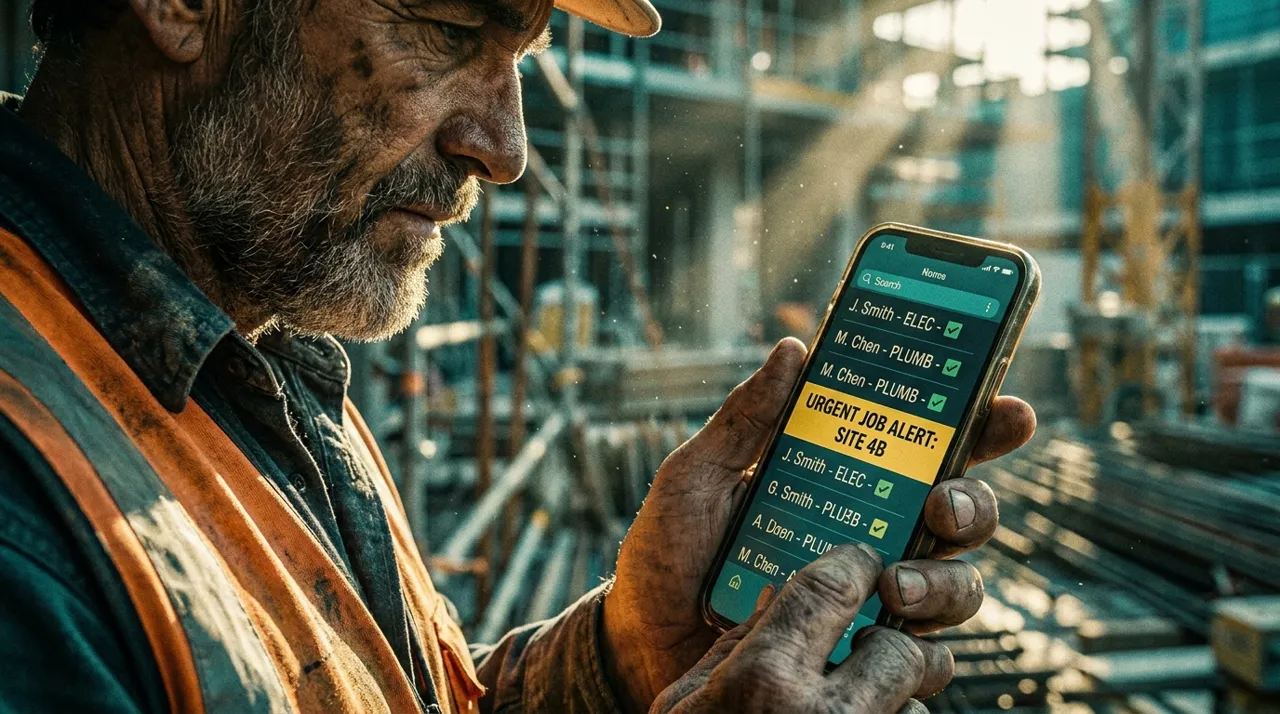
This is the part that has genuinely changed since your workmates started out. A phone in your pocket is now a good translator, and it costs you nothing to carry.
Use it for three specific jobs.
1. Camera mode, for anything printed. Point your phone at it and read the translation on the screen. This is the best use by a distance, and it works on the paperwork that actually matters:
- Chemical and product labels, especially the warnings
- The SWMS and the safe work method for your task
- Site signage, exclusion zone signs, muster point signs
- Your payslip, your roster, your induction paperwork
- Machine controls and warning stickers
2. Voice mode, for a slow two way exchange. You speak, it plays your sentence in English, he replies, it plays it back in your language. Good for a real conversation at smoko or in the site office. Slow, but it works.
3. Photo plus a question, to name the thing. Take a photo of the tool and ask it: "What is this tool called in Australian English, and what is it used for?" You get the word, the alternative name, and often the slang.
Now the honest part, because a translator used badly makes you look worse, not better.
Check the Australian term every time. A translation app will happily give you a flashlight, a dumpster, a wrench and a Sheetrock. On a Sydney site those are a torch, a skip, a spanner and gyprock. Same object, wrong word, and the wrong word costs you two minutes of confusion every time you use it.
Never let the phone be your safety check. If a supervisor gives you an instruction about a live risk and you did not follow it, the app is not the answer. A human is. Ask him again, and if you still did not get it, ask him to show you.
A translator is for preparation, not for the moment. Read the label before you start. Ask the human when it matters.And keep the phone away during the task itself. On a site, a bloke on his phone reads as a bloke not paying attention, even when he is doing the right thing.
What do you say on site while your English catches up?
This is the section that matters most, because these five habits will carry you through months where the words are still missing.
1. Say "show me once"
The single most useful sentence on an Australian site. It is short, it is normal, and every supervisor understands it immediately.
Most site tasks are physical. Watching it once is worth ten explanations, and it takes less of his time than an explanation does.
Nobody thinks less of you for it. New workers who speak perfect English say it too.
2. Repeat the instruction back in your own words
If you take one thing from this whole guide, take this one.
He says: "Take the barrow round the back, load the offcuts, and stack them by the bin."
You say: "So, barrow to the back, load the offcuts, stack near the bin. Yeah?"
Three things just happened. You checked your understanding. He got a chance to correct you before you wasted an hour. And if it later goes wrong, there is a record that you confirmed the task and he agreed.
Repeating it back is not a sign you are struggling. It is what good workers do in every language.
3. Ask for it written down or pointed at
"Can you show me where?" and "Can you write the number down?" solve most of the rest.
Measurements especially. Numbers spoken fast in a second language are the easiest thing in the world to get wrong, and a wrong number cuts the timber wrong.
4. Learn the names of the people around you
Names are the cheapest English you will ever learn and they change how the crew treats you.
Learn the leading hand, the foreman, and the three or four people you work beside. Use them. A worker who says "Dave, where do these go?" is part of the crew. A worker who says nothing is a stranger with a shovel.
5. Never pretend you understood a safety instruction
Nodding is the habit to kill. It feels polite. It is the most dangerous thing you can do on a site.
🦺 Say it plainly: "Sorry, I didn't get that. Can you show me?" Ask twice if you have to. Nobody on a Sydney site has ever been sacked for asking a safety question. People have been hurt for nodding.
What supervisors actually notice. Not your accent. They notice whether the right thing arrives, whether you are where you said you would be, whether you ask before you guess, and whether they have to check your work twice. Every one of those is available to you on day one, with the English you have right now.
What about site inductions and toolbox talks?
These two are where most language stress lands, and both are more forgiving than they look.
The site induction happens before you start on a site. It covers the site rules, the hazards, the emergency plan, the muster point, and who to report to. It is often the fastest talking anyone will do at you all month.
A toolbox talk is a short safety meeting, usually at the start of a shift, about one topic. What is happening on site today, what changed, what the risk is.
You are allowed to ask for things to be repeated in both.
Two practical moves.
Ask for the paperwork. Most sites will hand you the SWMS or the induction pack. Take a photo of it and run it through camera translation at smoko. Ten minutes, and you will understand more of that site than half the crew.
Ask after, not during. If the talk is running, note your questions and catch the supervisor at the end. You get his full attention and you have not slowed the crew.
📋 If you are brand new to sites entirely, the ground rules of a first job are worth reading before your first induction, and the desk to site guide covers a lot of the same first week ground from a different starting point.
What does WHS law say about instructions you did not understand (2026)?
Here is the part almost nobody tells new arrivals, and it changes how you should feel about asking.
The duty to make sure you understood safety information does not sit with you. It sits with the business.
Under the model WHS Regulations maintained by Safe Work Australia, a person conducting a business or undertaking must ensure that the information, training and instruction given to a worker is suitable and adequate for the work and its risks. The same regulation requires, so far as is reasonably practicable, that it is provided in a way that is readily understandable by any person to whom it is provided.
Read that last part again. Readily understandable by the person receiving it. Not delivered. Not signed for. Understandable.
The model regulations are the national template. Each state and territory implements its own version, so the wording in NSW is in the NSW WHS Regulation, but the duty is the same one.
So what does that mean for you on a Tuesday morning?
- When you ask for a safety instruction to be repeated or shown, you are helping the business meet a legal duty, not being difficult
- A supervisor who tells you to work it out is not just being rude, he is stepping around that duty
- If a site regularly gives safety information in a way people cannot follow, that is a site problem, and it is worth raising with your agency
And if you ever feel you cannot raise it on site, raise it with your employer. If you are working through a labour hire agency, your agency is your employer, and safety concerns on a host site are exactly what your allocator is there for.
Get Started
Reliable, safe and willing beats fluent. Every single time.
Your English will improve faster on a site than in a classroom, because you hear the same fifty words every day in the exact situation where they mean something. Employers do not care whether you sounded good. They care whether you understood, and whether the work got done right.
If you are ready to start, browse the Sydney job board or get on the find work list in 60 seconds. Tell us the language you are most comfortable in when you do, so the person who calls you knows to slow down.
Frequently Asked Questions
Can I work on a Sydney construction site if my English is not good?+
Yes, plenty of people do. What a site needs from you is that you understand the instruction and the safety calls, not that you speak perfectly. You need enough words to follow a task, ask a question, and react to a warning. Everything else you build on the job.
Why does school English not help me on a construction site?+
School teaches grammar, tenses and small talk. A site runs on tool names, material names, measurements, directions and short safety calls. Almost nobody teaches those words in a classroom, so you have to learn them yourself, on purpose, before you need them.
What English words should I learn first for construction work?+
Learn four groups in this order: the safety calls you must react to instantly, the tools you will hold every day, the materials your trade uses, and the measurement and direction words. Twenty words of your own trade beat two hundred general words.
Can I use a translation app on a construction site?+
Yes, and you should carry one. Use the camera mode to read labels, signs and paperwork, and the voice mode for a slow two way conversation. Do not use it in the middle of a task while someone is waiting on you, and never use it as your only check on a safety instruction.
What do I say when I do not understand an instruction on site?+
Say show me once, then repeat the instruction back in your own words. Those two sentences fix almost every misunderstanding on a site, and they protect you if something later goes wrong. Never nod when you did not understand.
Whose job is it to make sure I understood a safety instruction?+
Under the model WHS Regulations, the business must provide information, training and instruction in a way that is readily understandable by the person receiving it. That duty sits with the business, not with you. Asking for it again is you helping them meet it.
Can I ask for something to be repeated in a site induction or toolbox talk?+
Yes. An induction and a toolbox talk exist so that everyone understands the risks on that site. If you did not follow a part of it, saying so is the correct behaviour, and a good supervisor will show you rather than repeat the same words louder.
Will my English improve faster if I start working?+
Usually yes, because you hear the same fifty words every day in the situation where they matter. A site gives you repetition, context and immediate correction, which is more than any night class can give you on its own.