

Leading Hand to Foreman: The Jump Nobody Explains on a Sydney Site
The leading hand to foreman jump in Sydney: what actually changes in the job, the tickets and paperwork skills that matter, and how to get positioned before the role opens.
The leading hand to foreman jump is a change of job, not a promotion within the same one.
- What changes: you are measured on sequence and readiness, not on what you personally finished
- Who you manage: mostly people who do not report to you, especially subcontractors
- What you inherit: SWMS review, inductions, toolbox talks and a daily written record
- What matters most: coordination and documentation, not another plant ticket
- The qualification: no licence exists for foreman. The Cert IV CPC40120 is the practical filter for larger builders
- How to get picked: do the non-tools parts of the job before the title exists
The rung below this one is the leading hand step, which runs on trust. This one runs on evidence.
Most workers get told how to become a leading hand. Almost nobody explains the next step.
That silence is not an accident. The leading hand step is a promotion inside a job you already understand. The foreman step is a different job wearing the same hi-vis.
Leading hand is the best version of the job you already do. Foreman is a resignation from it.This post is about what actually changes, what the builder is really assessing, and how to get positioned months before the role opens up.
If you are still working towards the leading hand nod, start with our labourer to leading hand playbook. If you want the salary bands and the Cert IV path in detail, that lives in the Sydney site supervisor guide.
Table of Contents
- What actually changes when you become a foreman?
- Why do good leading hands get passed over?
- What skills is the builder actually assessing?
- Which tickets and paperwork matter now?
- How do you get the experience before the title?
- Should you actually take it?
- Frequently Asked Questions
What actually changes when you become a foreman?
Three things change, and only one of them is obvious.
You stop being measured on output. As a leading hand, a good day is a finished task. As a foreman, a good day is one where the next trade can start on time. You can have a crew that worked beautifully and still have had a bad day, because the sparkies could not get in behind you.
You manage people who do not report to you. This is the part nobody warns you about. Your crew is the easy half. The other half is subcontractors, delivery drivers, other trades and the client's representative, none of whom you can direct. You get things done through negotiation and sequence, not instruction.
You inherit the paperwork, and it is real. Not admin busywork. Under the NSW Work Health and Safety Act, the PCBU holds the duty, and the foreman is usually the person operationally discharging a large part of it on the ground.
| Criteria | Leading hand | Foreman |
|---|---|---|
| Measured on | Task completed | Sequence and readiness |
| Time on the tools | Most of the day | Little to none |
| Who you direct | Two to six of your own crew | Crews, subbies, deliveries, other trades |
| Main tool | Whatever is in your hand | The program and the phone |
| Documentation | Sign what you are handed | Own SWMS review, inductions, toolbox, daily diary |
| When it goes wrong | You fix it | You are asked why it happened |
| Earned through | Trust | Evidence |
Highlighted cells = best option per criterion
Why do good leading hands get passed over?
Because being excellent at the current rung is not evidence for the next one. The two jobs test different things.
The pattern we see repeatedly on Sydney sites is the same. The best leading hand on the job gets overlooked, and someone with less time on the tools gets the nod. It looks unfair. It usually is not.
That last one costs more people the role than any skill gap.
A builder appointing a foreman is making a bet with real money behind it. They pick the person whose coordination they have already watched, not the person they suspect might be good at it.
📋 The thing nobody tells you. By the time a foreman role is advertised internally, it is usually already decided. The assessment happened over the previous six months, in the small jobs you either took or ducked.

What skills is the builder actually assessing?
Four, and none of them are about how well you swing a tool.
Reading and thinking in program. Can you look at the schedule and say what is at risk in ten days? A leading hand thinks in today. A foreman thinks in next week, because that is when the recoverable problems still are.
Coordinating without authority. Getting a subbie who is behind, who does not work for you, to change their plan. That is negotiation, relationships and being someone people would rather help than avoid.
Escalating with an option attached. There is a large difference between "the slab crew is holding us up" and "the slab crew is two days behind, I can move the crew to the eastern side to keep them productive, do you want me to?" One is a complaint. The other is a foreman.
Written record keeping. Diaries, delays, variations, inductions, toolbox records. This is genuinely the skill most tools-first workers underestimate, and it is the one that protects the builder when something goes wrong months later.
The foreman jump is a swap: hand skills for judgment, and today for next week.
Arrive with an option, not a problem. That single habit does more for your case than any course.Two related skills are worth building deliberately: giving instructions people actually retain, covered in our five finger rule for site instructions, and handling the conversation when someone is underperforming, which we break down in the difficult conversation script.
Which tickets and paperwork matter now?
Here is the shift most people get wrong: the tickets that got you to leading hand are not the ones that get you past it.
Plant and high risk work licences like EWP, dogging, forklift and confined space move you up the labouring rungs. They are worth having. They are also, at this point, no longer the differentiator, because the foreman is not the one operating the plant.
The Cert IV CPC40120 is the honest fork in the road. Small subcontractors and plenty of civil outfits will promote a capable person without it. Larger builders often will not get past their own filter.
⚠️ Do not enrol in a Cert IV as a substitute for experience. Builders can tell the difference between a person who did the course after running an area and a person who did the course instead of running one. Get the exposure first, or run both together.
The full cost, subsidy and part-time timeline for the Cert IV sits in our Sydney site supervisor and Cert IV guide. For where the plant tickets still pay, see the best tickets to get after your White Card.
How do you get the experience before the title?
You volunteer for the parts of the job the current foreman would happily hand over. There are more of them than you think, and they are almost always available.
The foreman on your site is overloaded. That is not a complaint about them, it is the nature of the role. Anything credible you offer to take off their plate, they will usually say yes to.
That last item is the one that matters most. Coordinating a subbie you cannot direct is the foreman job in miniature, and doing it once successfully is worth more than a year of being a reliable leading hand.
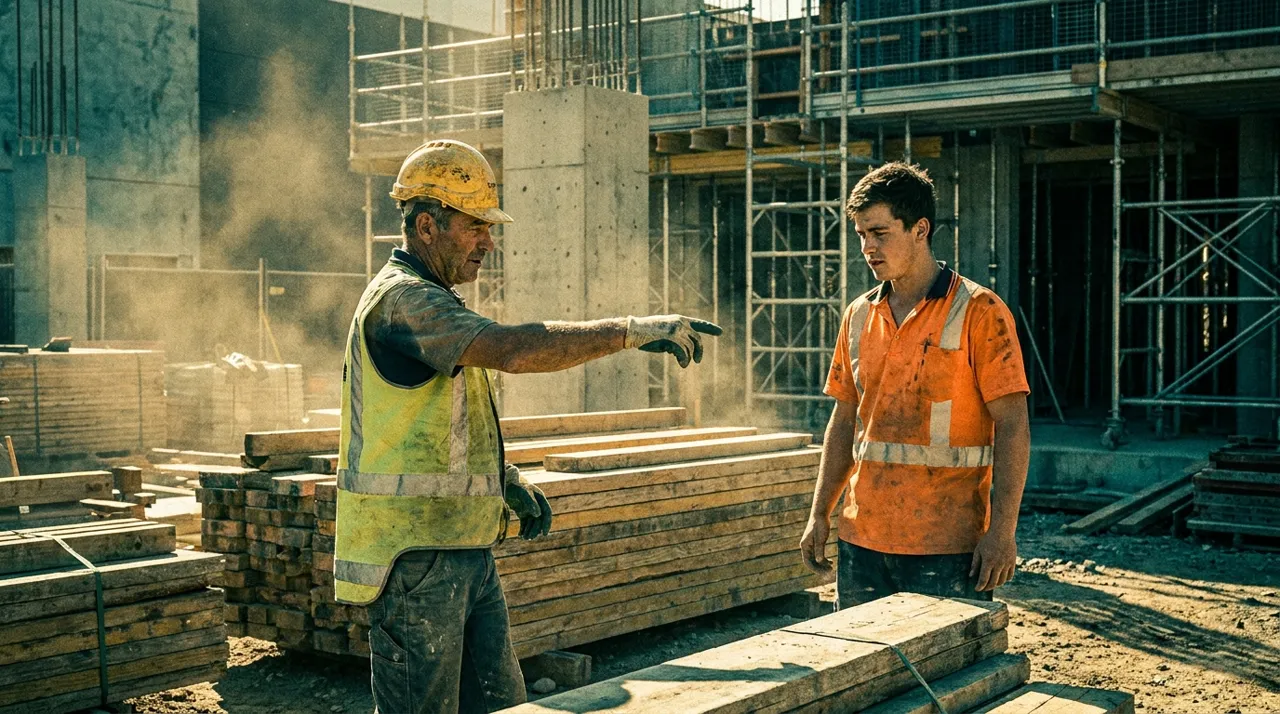
Then say it out loud. Tell the site manager or the builder, once and plainly, that foreman is the direction you are heading and ask what they would want to see from you first.
Ask what they need to see. Most workers wait to be noticed. The answer is usually specific and usually achievable.Where labour hire helps, and where it does not
Labour hire cuts both ways on this jump, and it is worth being straight about it.
It helps on exposure. Working across multiple builders shows you how different outfits run a program, sequence trades and handle documentation. That comparative view is genuinely valuable and permanent staff rarely get it.
It hurts on continuity. A foreman appointment needs a builder who has watched you coordinate over months. Scattered one-off shifts across ten sites do not build that.
The practical move is to tell your allocator what you are chasing. At Leap, supervisors flag standouts and clients ask for people by name, and that record is what we match against when a higher-responsibility role comes up. We can steer you toward repeat work with one head contractor instead of spreading you thin, which is exactly what this step needs.
Our systems track the signals, who turns up, who runs an area clean, who gets requested back. A human still makes the call on who is ready.
Should you actually take it?
Worth asking honestly, because the answer is not automatically yes.
You give up the thing that probably made you good at this in the first place: finishing something with your hands and seeing it done. In exchange you get responsibility, a phone that does not stop, and being the person everyone escalates to.
Some workers find the foreman job is the best work of their lives, because they were always solving problems and now that is the whole job. Others take it for the money, hate it, and go back to the tools inside a year. Both are legitimate. The mistake is taking it without knowing which one you are, and the cheapest way to find out is to do the non-tools parts of the job before the title makes it permanent.
If money is the main driver, look at the numbers before you assume. The Sydney labourer five year salary curve shows that a heavily ticketed skilled labourer on good overtime is not always behind a first-year foreman on salary. Run your own maths on the Fair Work Pay and Conditions Tool rather than on site rumour.
Get Started
The jump is not a course you enrol in. It is a set of jobs you take before anyone asks you to.
Pick two things off the list above this week. Run the toolbox talk. Take the SWMS review. Then tell your site manager where you are heading and ask what they need to see.
If you want repeat work with builders who promote from within, rather than whatever shift is nearest your suburb, get on our find-work list or browse the Sydney job board. Tell your allocator you are chasing the foreman path and we will match you accordingly. It also pays to read how people build a real career through labour hire over the long run.
Frequently Asked Questions
What is the difference between a leading hand and a foreman?+
A leading hand runs a small crew on one task and still works on the tools. A foreman runs the program for an area or a whole site, coordinates multiple crews and subcontractors, and is measured on sequence rather than output. The leading hand is judged on whether the task got done. The foreman is judged on whether the next trade could start on time.
Do I need a Cert IV to become a foreman in NSW?+
Not by law. There is no licence called foreman in NSW. In practice head contractors and tier-two builders increasingly filter on the Cert IV in Building and Construction (CPC40120), and it is the qualification that feeds into a builder licence later. Small subcontractors and civil outfits still promote on demonstrated capability without it. The cost and part-time timeline are covered in our site supervisor and Cert IV guide.
What tickets actually matter for the foreman jump?+
The White Card is assumed. Beyond that the ones that count are supervision and safety credentials rather than plant tickets: a recognised WHS or supervisor safety course, first aid, and whatever high risk work licences match your area of the job. Plant tickets help you get to leading hand. Safety and coordination credentials help you get past it.
What actually changes when you become a foreman?+
Three things. You stop being measured on your own output and start being measured on sequence and readiness. You inherit real documentation duties including SWMS review, inductions, toolbox talks and daily records. And you spend most of your day coordinating people who do not report to you, mainly subcontractors and other trades.
How long does the leading hand to foreman step take?+
There is no fixed timeframe because it is not a course. The bottleneck is exposure to the coordination side of the job, not years served. A leading hand who deliberately learns programming, SWMS and subcontractor coordination usually gets there faster than one who simply stays a good leading hand for longer.
How do I get foreman experience before I have the title?+
Volunteer for the parts of the job that are not on the tools. Run the toolbox talk, take the SWMS review, sit in on the coordination meeting, own the daily diary for your area. These are jobs the foreman is usually happy to hand over, and they are exactly the evidence you need when the role opens.
Does labour hire help or hurt the jump to foreman?+
It helps on exposure and hurts on continuity. Moving across builders shows you how different sites run their program, which is real education. But a foreman appointment needs a builder who has watched you coordinate over months, so you need a run of repeat work with one head contractor rather than scattered one-off shifts. Tell your allocator that is what you want.
Is the foreman job actually worth taking?+
Not for everyone, and it is worth being honest about that. You trade the satisfaction of finishing something with your hands for responsibility, paperwork, and being the person everyone escalates to. Some workers thrive on it. Others take it for the money and go back to the tools within a year. Do the non-tools parts of the job first and you will know which one you are.
Do the job before you have the title. That is the whole method.
Want repeat work with builders who promote from within? Get on our find-work list
Leap Labour is a Sydney-based labour hire company providing general hands, forklift drivers, skilled labourers, traffic controllers and leading hands across construction and warehouse sectors. All placements comply with Fair Work and SafeWork NSW requirements.